

Image: Otago Daily Times - Arch Jelley visits Mornington School
On August 13th Lisa Owens of RNZ interviewed Arch Jelley on his 102nd birthday. Arch is best known as a coach of high-performing New Zealand athletes. He talked about the form of the New Zealand athletes at the Paris Olympics. He also pointed out that improved performance over decades was in part a function of track surfaces and better running shoes. Arch shared some lifestyle tips – he walks three to four km a day, does daily squats (90-100 of them), and regularly plays bridge.
These are not recent lifestyle changes for Arch. When I stayed with his family (in the 60s) Arch was a harrier. What that means is that blokes would come over in the weekend and they would go running. He encouraged his sons’ mental arithmetic skills with financial rewards (pennys – this was pre-decimal era). I didn’t join in the mental arithmetic – maybe too slow?
For Arch great genes and great life-stye have contributed to his physical and mental health-span.
Research continues to point to the lifestyle factors that could help our health-span, including our brain health.
We know that our brain makes big energy demands. There are about 170 billion nerve cells at work. Even when idling the DMN (default mode network) is ticking over – reviewing our social life, our To Do list. As we know, the brain makes up around 2% of our weight and needs 20% of our energy supply.
The fuel is glucose – converted from what we eat and drink. Then it takes a well-functioning cardiovascular system to pump glucose to the brain. There, brain cells metabolise the fuel and produce waste.
This fits with the evidence that foods such as those high in omega-3s, exercise that keeps the heart fit, and 8 or so hours sleep (which provides the opportunity for waste to be flushed away) all contribute to brain health.
Christos Davatzikos and 51 fellow researchers go further to explore how lifestyle helps or hurts the brain. They have collected brain MRIs from over 49,000 healthy and diseased people. They used an AI model (“Surreal-GAN”) to identify five patterns of “brain atrophy”. Of these five “R-types” the R2, 3 and 5 types are associated with varieties of dementia. R2 was strongly related to memory (or lack of it), R3 with executive function.
Multiple sclerosis was related to factors R3, 4 and 5 – indicating this disease is involved with different cortical systems.
Parkinson’s disease and schizophrenia were most related to R3 – implicating the parietal lobe (at the back of the brain) and temporal lobes (at the side) of the brain.
The R5 syndrome has relationships to perisylvian disease (affecting the language regions of the brain) and related psychiatric symptoms.
Davatzikos and the team identified which lifestyles were related to these different pathologies. Details of these syndrome-specific results are shown in the graphic.
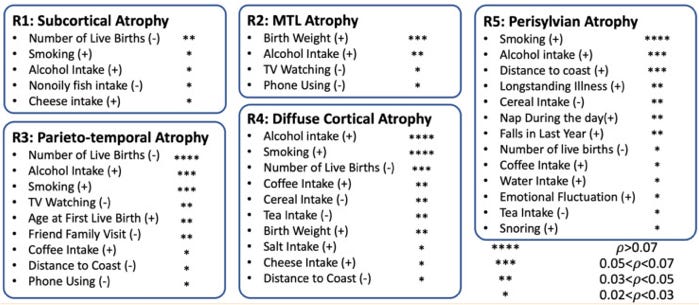
From Figure 4c, Davatzikos et al, 2024
That’s a lot of information. Some points – the bullet-pointed life-stye factors for each disease state are ordered by the size of the (partial) correlations. These correlations are a guide to the size of the relationship of that lifestyle factor with the syndrome after controlling for the other measures. They are small (the “four-star” correlations are greater than 0.07, one-star indicates a correlation between 0.02 and 0.03). Some factors are positively related to that syndrome – potentially harming (coded as “+”), while some are negative – helping (“-“).
A caution – these correlations might not indicate causation. For example, the role of alcohol might indicate attempts at self-medication to cope with the consequences of brain issues – the brain disease instigating the drinking rather than the other way around.
Having said that, alcohol is implicated in all five of the different disease syndromes. Smoking shows up in four. Also apparently not helping are coffee, cheese and salt. On the positive side are tea and cereals.
Are there some surprises here? The researchers cite research indicating that having children does help brain function so this correlation in three of the disease states is not a complete surprise.
How about getting omega-3s in the diet? This research indicates that “nonoily fish” is negatively correlated with R1. How about a decent amount of sleep? There are some indications with R5 – naps and snoring stick out – perhaps indicating poor sleep. What about exercise? A complete no-show (despite evidence of exercise helping cognitive function). My theory is that most of those in the study do little exercise so it doesn’t feature as a factor. I know – it sounds weak.
Still – food for thought.