Bruce McLaren
Poised and charismatic on and off the track

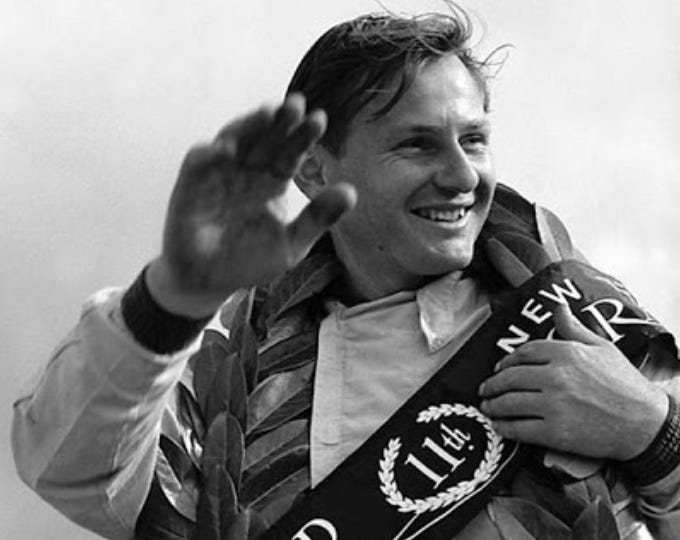
The first Can-Am sports car race of the 1968 series was due to kick off on 1 September. In the previous year of this new racing format – racing what were then the fastest cars on the planet – the McLaren team had had a fantastic streak – winning five of the six races. “In mid-June [1968], Bruce breezed into the workshop and announced he would be testing the car the following Monday.” Mechanic George Begg: “All of us looked at him in utter disbelief. The day was Wednesday and there seemed to be at least two weeks work that remained to be done. Everyone from the factory pitched in night and day for the whole weekend.”
Some charismatic individuals can switch on a ‘reality distortion field’. McLaren had what mechanic and fellow-Director Tyler Alexander described as the ‘woosh-bonk’ approach: “If Bruce had one of his theories, even if it was crazy, he was able to make it happen … ‘You take the suspension off the sports car – whoosh – knock up a chassis, and – bonk – there’s the car!’”
In 1968 the McLaren team raced the 430 cu in (7 litre) Chevrolet V8 powered M8A. Between McLaren and co-driver Denny Hulme, their phenomenally fast and loud orange wedge-shaped cars won four of six races (the other two were won by customer McLarens). Next year team McLaren achieved the clean sweep, winning all 11 races.
Bruce McLaren attributed their success to the exceptional engineering of the cars. For example, using mechanics who had experienced the pressure of preparing and repairing Grand Prix cars was an advantage in the Can-Am environment – they were more competitive.
Others noted his ability to build a high-performing team. Alexander described: “We used to argue like hell over how something should be done, but we never seemed to get upset about it, and we always ended up with a reasonable solution.”
McLaren’s poised personality combined an outgoing, friendly, ‘can-do’ approach with phenomenal steadiness. This meant he was fearless in social settings as well as when driving a racing car at 160 miles per hour. Positive sociability plus rock-steadiness under pressure provided reassurance to his team about what was possible (‘woosh and then bonk’!) and gave him an edge in a range of social settings.
A chat with a Can-Am competitor illustrates. The competition was running the same Chevrolet engines as team McLaren. Bruce McLaren reasoned that they might be having the same problem they were facing. The competition mechanic Mark Donohue: “Bruce came walking up and started joking around, and he very casually said: ‘Why do you suppose we’re breaking these motors?’ And dammit, I stood there and listened to myself tell him exactly what I thought the problem was!”
Poised, gracious and able to take charge and set the agenda, McLaren was able to bring people along with his priorities. His limited emotionality resulted in steady nerves in high-stakes situations. Such charismatic people are at ease under pressure, while there is also the potential to leap optimistically where others might have paused.
It is easy to leap in when ‘positivity’ is turned up and ‘threat sensitivity is way down low. McLaren was conscientious – and encouraged a team culture of being well prepared: “Ever since I’ve been in racing I’ve managed to have good cars, to prepare them well – I used to prepare them myself originally – and always make sure we’re ready and get there before other people and be the first through scrutineering and so on.”
An approach to manage over-enthusiasm is to have external constraints – such as team ‘Go/No-go’ guidelines. Team McLaren had excellent review processes to monitor car performance, but there is no mention of such safety reviews in place in the racing teams. This was in an era where in F1 racing anyway, the annual driver fatalities were between 12 to 14. In contrast, in more recent decades F1 driver deaths are between 2 and 4.
McLaren was probably unexceptional among drivers in being fearless. A classic study of the personality of climbers at Everest Base Camp found they were remarkably low in their ‘nervousness’ (despite the average climber fatality rate on Everest of around 1%). That makes sense – those with a realistic idea of the risks involved in climbing Everest wouldn’t be there.
McLaren was preparing for the 1966 Le Mans race and noticed that his 289 cu in (4.9 litre) powered Ford GT40 would develop an electrical miss at speeds above 160 miles per hour. After practice he offered to drive Roy Lunn, the head of the GT40 programme back to his hotel: “It was about 11:30 at night going across the rolling French countryside and it was the most hairy ride I’ve ever had in my life. By the time we got it up to 160 mph, he leaned over and shouted, ‘Can you hear it missing?’ Hear it missing – Man, I was hearing angels singing…!”
On 2 June 1970 McLaren took the M8D model Can-Am racer out for a test drive. The rear bodywork detached at speed, the consequent loss of aerodynamic downforce destabilised the car which spun out and hit a bunker. McLaren was killed instantly.
McLaren left the legacy of the McLaren super-car. The qualities of positivity and fearlessness that had helped to propel his success – as driver, car-designer, and entrepreneur, may have also contributed to his taking one risk too many. The value of safety systems is that they will ensure that individual personality and unique team cultures don’t get in the way of creating a safe environment.
Stewart Forsyth is an executive coach and organisational psychologist. He is the author of eBook 21 Remarkable People