Career goals
Are they a thing?


Image: shutterstock.com
You need AMO to sustain a career. That’s Ability, Motivation and Opportunity. If you are looking for a new job – the opportunity, you need to get out and pitch your experience, knowledge and skills – the ability part of AMO. That takes motivation.
Recently, I’ve been asking senior professionals about sustaining their careers past retirement age. Going beyond – “how do you keep on keeping on?”
Goal- setting is one of the most useful ways to lift motivation. People achieve more when they set goals, especially clear, demanding, written, goals that they share with others. In the course of a somewhat structured interview with legends working past age 65, I ask them about the extent to which career goals focused their energy and effort at different times in their career. Particularly in their early, mid-career and recent jobs.
More than a few are bemused by the assumption that they would have spelt out their aspirations in such detail.
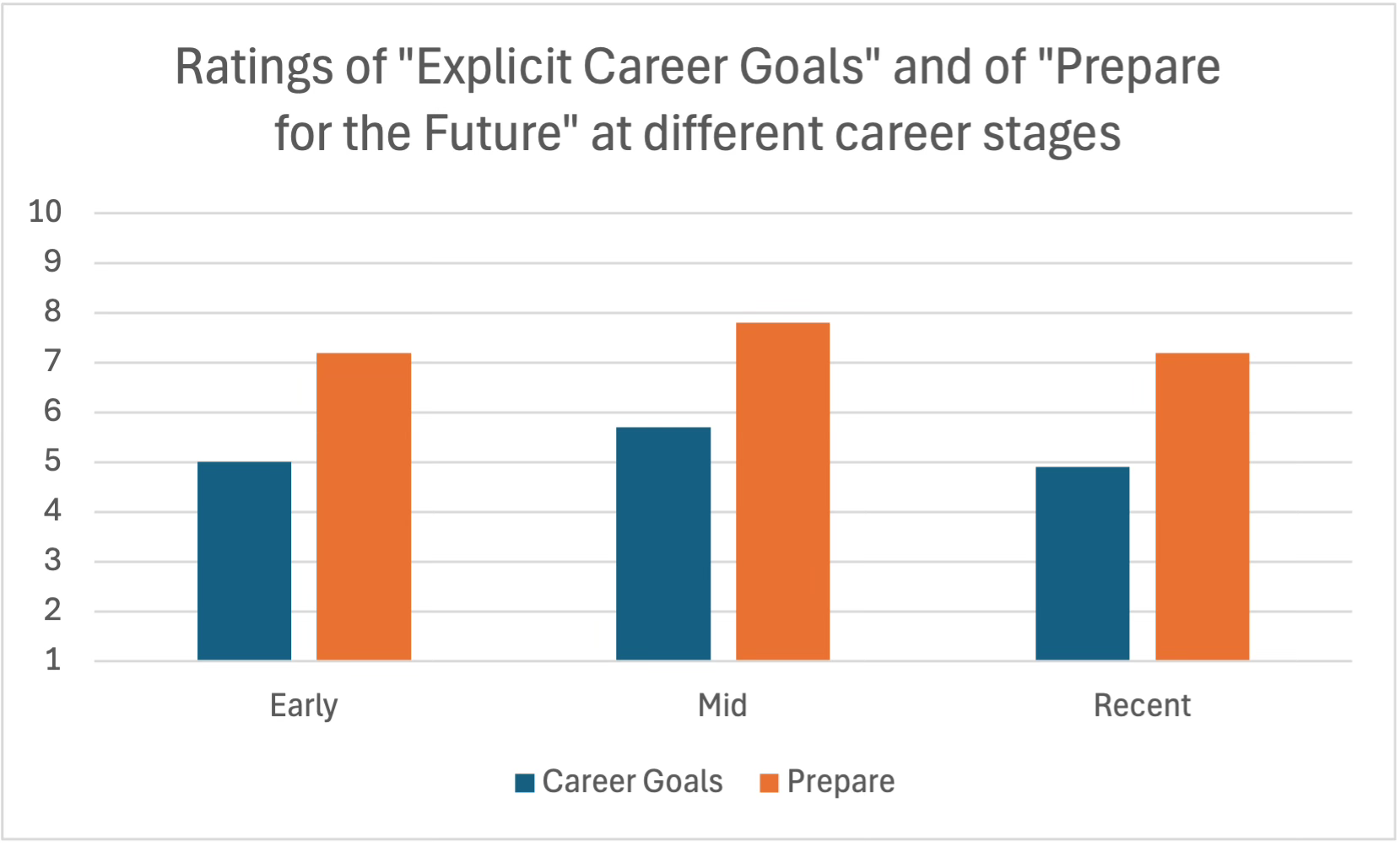
The ratings of these career sustainers (from 1 to 10) for setting career goals are easily the lowest of the ratings they give for how they have managed their careers. However, these older professionals are more likely to give higher (though not super-high) ratings for how they “prepared for the future” at early, mid-career and recent jobs.
For example, as retirement age zoomed into view one careerist spotted an opportunity to move into a role inspecting infrastructure. They obtained relevant registration, made connections, and started picking up work. No written goals or action plan. Just flexing skills and connections to make a successful career transition.
Some possible explanations for the limited role of goals in motivating career development:
Maybe (in fact definitely!) I haven’t got a big enough sample – adding more people may change the picture (see below).
Another possibility is that this cohort of seniors worked in a professional and organisational culture where career progression happened in an organic rather than planned way. If you did well you would progress to senior, associate, then partner or director. You didn’t need goals; you just went up the escalator.
Related to this is the influence of mentors. Other people might have recognised their capability and planned for their success. One such professional described a positive career shock when the MD chatted to them about getting company support for an advanced qualification. That definitely changed their career.
Another possibility is that near and far goals are different. You may set a goal to develop a new product or to get your professional registration – the sorts of things that could kick your career along. But you might not see the point of setting a goal to be recognised as successful in your new career in five years.
These professionals have thought ahead and planned for the future. That motivated them to get the opportunities that would build skills and visibility. However modern professionals might not be able to rely on the automatic escalator to move them up.
People in new professions (such as data scientists or blockchain technical specialists) might not have the same professional ecosystem to provide a development path. Women and others who don’t look similar to top executives and leaders in their organisations might not get the same mentoring or opportunities that were available to young professionals in a more homogenous world.
Few people, professionals included, have a mentor or coach who can introduce them to the value of clarifying values-aligned goals for a satisfying career (and a rich and fulfilling life).
If you are such a coach or mentor, you can help your mentees and coachees to understand the value (as well as the limitations) of goal-setting.
Meanwhile – I’m looking for more people who are maintaining their career past 65. Please reach out or invite a friend to make contact to talk to me about your career.