Chicken to go
What chicken tell us about human migration

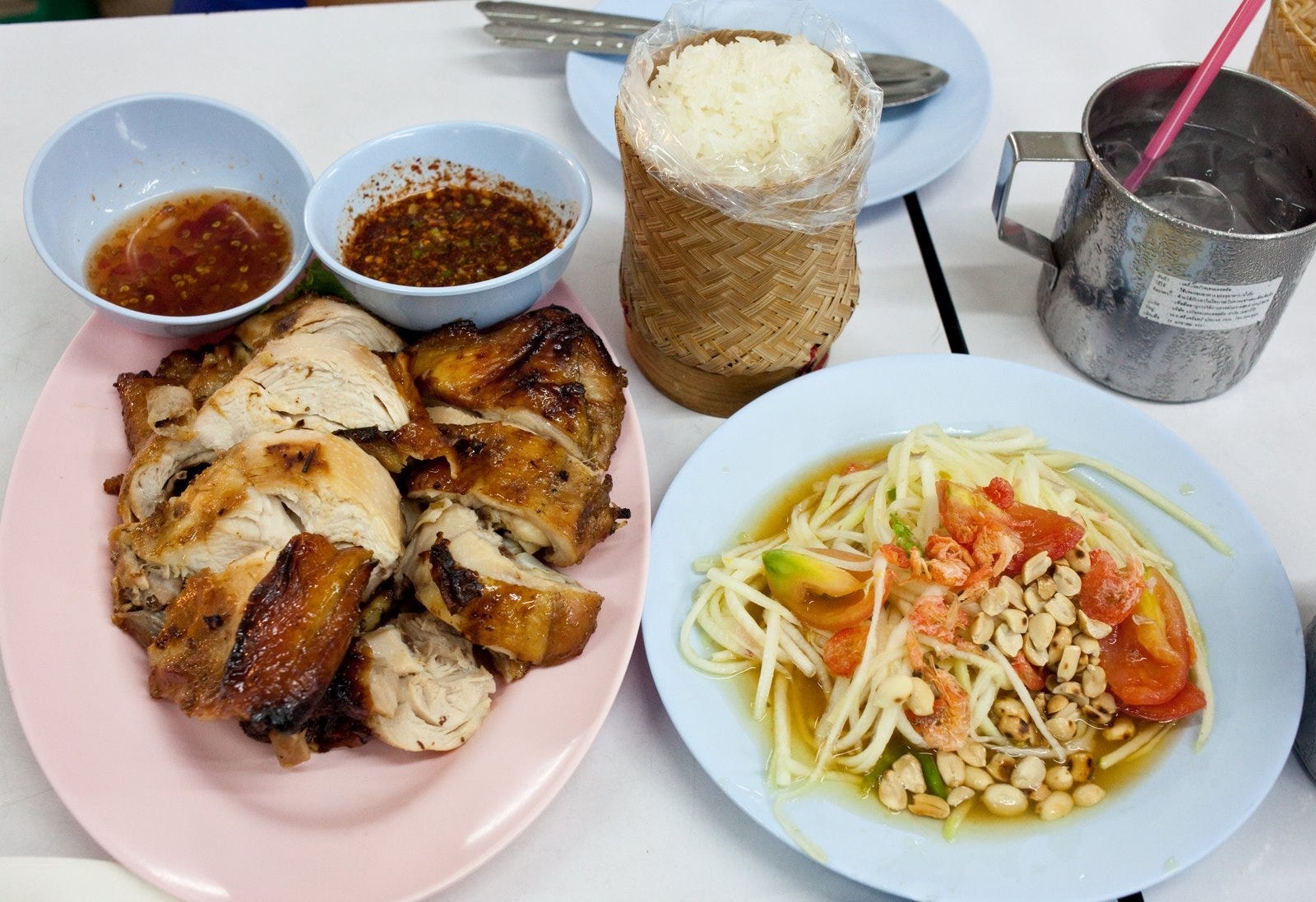
Image: Wikipedia Commons
“Gai yang, som tam, khao neo, ka / krup” (the last syllable – “ka” or “krup” for women and men respectively) – this phrase at the right food stall will get you a Thai taste sensation. Grilled chicken, spicy pawpaw salad and sticky rice. So many flavours and textures, from succulent chicken to the glorious hot, sour, crunchy salad and the mouth-satisfying and spice-mollifying glutinous rice.
Recent genetic evidence (published in June 2022) suggests the Thais have had time to get this combo zinging. Neolithic peoples who came from the north around 3,500 years ago set the scene. They settled to grow rice in a zone in present-day North-East Thailand. Their dry rice agriculture settlements overlapped with the range of the red jungle fowl. These birds made the trade-off of other domesticates; easy access to food and relatively safe life in exchange, in the case of chickens, for eggs and then the ultimate sacrifice on the charcoal grill.
Initially attracted to the grain in the fields and then the scraps left around the village the jungle fowl gradually became chooks.
From scratching a living in North-east Thailand chicken moved out west and north along trading routes. The archaeology indicates that the further west they were relocated, the more cachet they achieved. In Europe, they were venerated by local elites, lived to the old age of two or so, and often joined their rich and famous human companions as grave goods. Only after 400-500 years did they begin to be appreciated for their culinary qualities.
Chicken moved south and east as well, travelling as ‘commensal’ species – what could be good eating on arrival at the next destination. They arrived along with the ancestors of the Polynesians in the area around what we know as Vanuatu early in the first millennium BCE (that’s closer to 1,000 BC than 1 BC).
Chickens (along with pigs, dogs and Rattus exulans – the kiore) travelled on with these Polynesians in their ocean-going canoes out as far as the Hawai’i point of the Polynesian triangle, arriving there around 1200. There is no evidence this lineage of chickens made it to New Zealand. Dogs and rats did arrive here as fellow travellers with the Polynesian voyagers. Midden remains at the Wairau Bar, at the top of Te Wai Pounamu (the South Island), reveal many bird bones, including those of pouakai, or Haast’s eagle, four species of moa, but no chicken).
The earliest evidence of chickens in New Zealand have the fingerprints of James Cook all over them – these earliest chicken bones are dated to overlap with his second voyage of 1773-1774.
The enterprising Polynesians had meanwhile been voyaging further to the east, eventually finding the west coast of South America. Sailing up this coast allowed them to head back west on the equatorial winds. They come ashore around present-day Ecuador and picked up the sweet potato the locals called ‘comal’ or ‘’cuma’. This was relayed via a zone including the Cook Islands and western French Polynesia (kuma’a, ‘ūmā), north to Hawai’i (‘uala) and south-west to New Zealand (kūmara, kumala, ōmara). The makings were there for the Pacific dish of chicken and chips.
Stewart Forsyth is an organisational psychologist and executive coach and also the author of 21 Remarkable People – available from Amazon or Apple or other eBook sources.