Djokovic vs Federer
Rage vs joy

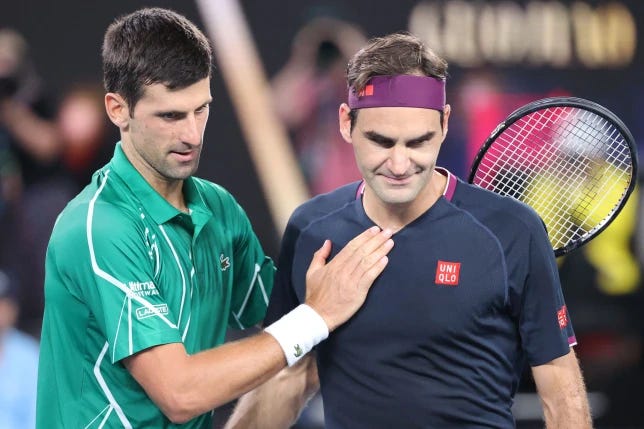
Image: David Gray / metro.co.uk
Djokovic was thrown out of the New York Open in September 2020. He had randomly volleyed a ball after losing a point. This was not the first time he’d smashed a ball in reaction to a setback. This time the ball hit a line judge in the throat. Djokovic protested that he did not intend to hit her, but after 10 minutes deliberation he was disqualified. For many, this was an accident waiting to happen, the natural culmination of Djokovic’s rage.
For many tennis fans there is a clear gap between Djokovic and the suave Federer. What is the difference? The similarities seem more obvious. They are both multi-linguals, comfortable in different cultures. Obviously both men are goal-oriented with the drive to work hard to maintain fitness and skill levels.
One of Djokovic’s super-powers (as well as being the near-perfect package of tennis skills) is his ability to come back. He never surrenders. At the 2019 Wimbledon final , the longest ever, Djokovic and Federer demonstrated how little separates them. In the final game Federer was only two serves away from match point. Yet Djokovic turned the game around and won his fifth Wimbledon final.
And when he wins, especially on the come-back, he might be accused of some triumphalism. Shirt off, fist-pumping sort of stuff.
But Federer wins the popularity stakes. In the Wimbledon final – the crowd was chanting for ‘Roger, Roger.’ In their eyes the wrong man won.
Federer has won the ATP (Association of Tennis Professionals) Fans Favourite rating every year since 2003. It’s not just the view of fans. Federer has won the Stefan Edberg Sportsmanship Award 13 times from 2004 to 2019 – this award is voted by the players. Over that same time Raphael Nadal has won it three times. Djokovic? Never.
As is well-known, Djokovic lived through two wars in his childhood. In 1999 while NATO planes were bombing the city of Belgrade, Djokovic remembers falling while running to his Grandmother’s bomb shelter and watching an F117 fire missiles at a nearby target. His coach would take him to practice near areas bombed the night before – on the reasoning they wouldn’t be hit again. Djokovic (as of 2014) cannot bear loud noises.
Federer had a less challenging early life. The son of professionals, he grew up in a Swiss city. He was a self-described “hot-head” on court, frequently smashing his racquet. Australian coach Peter Carter helped him learn that he was wasting energy with such outbursts, and the importance of controlling his emotions. In 1999 he was on the professional tennis circuit, and became the youngest member of the ATP Tour Top 100.
What seems to separate them is that Djokovic had to fight to get out of Belgrade, and he continues to fight. He has learned that being down is the signal for going on the attack. He responds to set backs with anger – on show with his random volley shots. He combines competitiveness with anger. Djokovic has an audacity that fuels his attack, even when the spectators have ruled him out.
Like any other useful approach, the motivational fuel of anger can be over-used. Close friend Daniela Huntuchova has described Djokovic as having an anger problem.
In contrast, descriptions of Federer emphasise the fun, joyful, relaxed and creative aspects of his practice and play. The mentions of his anger and temper tend to be from his early days as a hot-headed racquet-smasher.
“If you let yourself be blown to and fro, you lose touch with your root,” tweeted his wife Jelena Djokovic the day after he was disqualified. “If you let restlessness move you, you lose touch with who you are.” Rage-motivated success is a short-term tactic with a serious downside.
Stewart Forsyth is an organisational psychologist and executive coach and also the author of 21 Remarkable People – available from Amazon or Apple or other eBook sources.