Does autocracy kill innovation?
The example of the Koreas

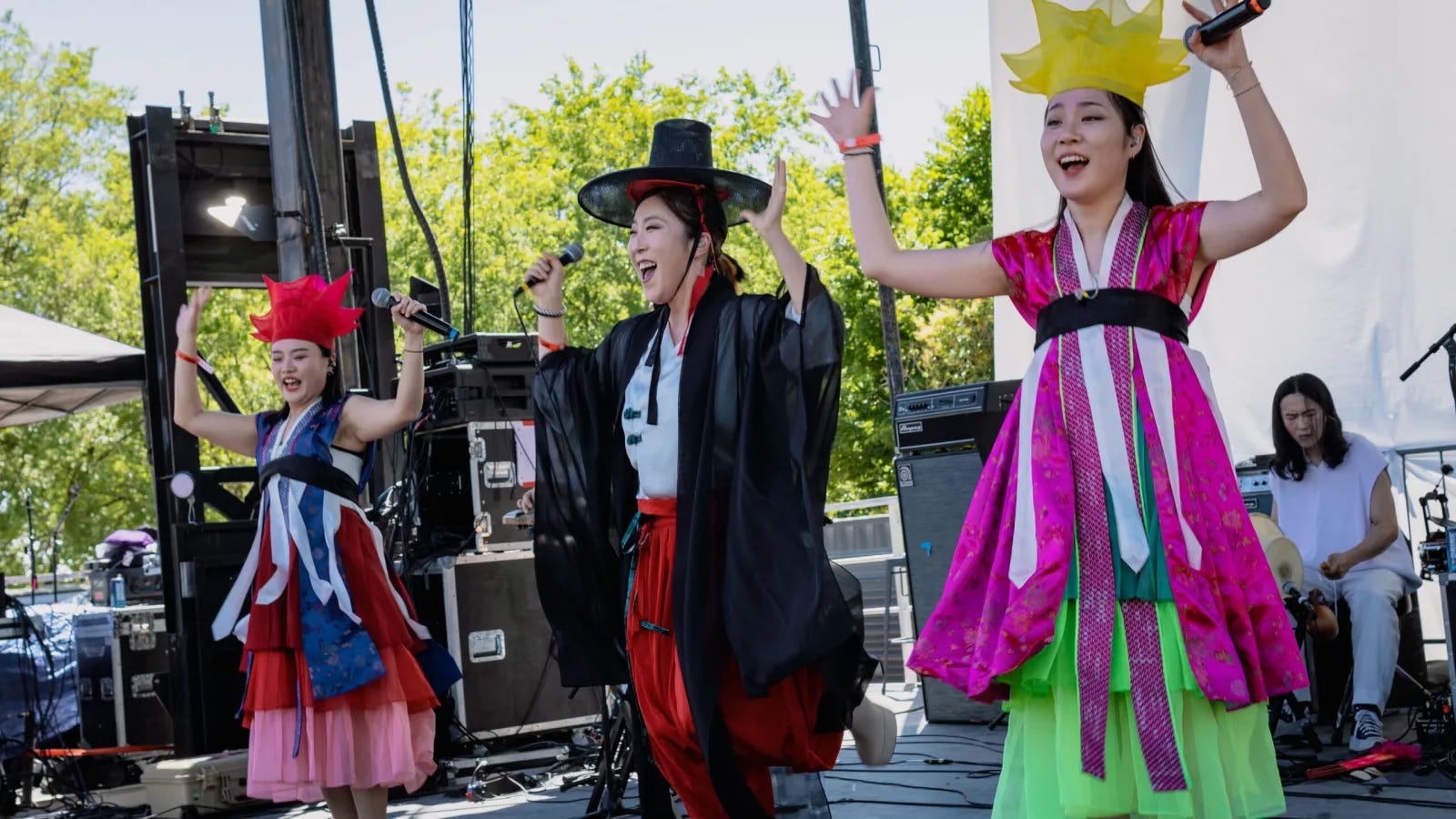
Image: Ak Dan Gwang (ADG7) in performance
You’ve heard of K-pop. You might even have heard it. K-pop’s impact is worldwide, not just South Korea or Asia. Supergroup BTS is touring over 85 dates in 34 cities across 23 countries, spanning 2026 to 2027, with stops scheduled for Tokyo, Los Angeles, Paris, London, and Bangkok.
The picture at the top shows a different Korean group – ADG7 have been described as “K-folk pop” and “Korean shamanic punk-rock”. They performed their theatrical high-energy show at Womad in 2023. An idea buzzed me as I watched them – “is it possible that such a group could emerge out of North Korea?”. Possibly inspired by seeing Anna Fifield spruiking her brilliant book – The Great Successor: The Divinely Perfect Destiny of Brilliant Comrade Kim Jong Un – at the same venue (Womad includes performers doing cooking shows, authors talking about their books as well as the incredible music and dance – and it’s coming back March next year!).
What is it about autocracies that kills creativity?
An autocracy is designed for the benefit of the autocrat, and the small elite that enables him to maintain his power (okay, sometimes her power, but not very often).
Fundamental to maintaining power is the subjugation of those outside the elite. These people are forced to conform because anything else could destabilise the system.
In Romania in 1989, after protests about economic hardship and the repression of protesters, the great dictator Nicolae Ceaușescu was making what was meant to be a stage-managed public speech. Somebody jeered. Then the whole audience jeered. Next, the army switched sides and Ceaușescu was arrested and executed.
Conformity is not just following the party line. It is also sticking to gender roles, intolerance of homosexuality, adherence to religious taboos, and the suppression of unseemly music. All managed by serious punishment for those outside the narrow definition of “normal”.
Remember Pussy Riot’s 2012 performance in Moscow’s Christ the Saviour Cathedral? They sang “Holy Sh*t” (often referred to as “Punk Prayer”) that criticised the close ties between the Russian Orthodox Church and the Kremlin. Three members were arrested and sentenced to two years in prison for hooliganism.
That’s absurdly punitive. In North Korea, which takes absurdity to horrific levels, consuming or sharing South Korean media including K-pop is a capital offence.
It is macabre, but the divergence of South Korea from North Korea is a remarkable social experiment. Up until the mid-20th century, there was no North or South Korea. Same people, same Korean culture. Then the country became a Cold War conflict zone between Russia and America. North Korea degenerated to a feudal monarchy. It wasn’t all happy times for South Korea. After the Korean War (1950-1953), there was a succession of dictatorships until the June Democratic Struggle of 1987.
How is this bizarre experiment going? If you’re in the South, you live 10-12 years longer (for women, life expectancy is respectively 88 or 76 years, for men 82 or 72 for South and North Korea, respectively). You are 26.5 times better off (per-capita GDP is around $53,000 rather than near $2,000 – that’s for South and North Korea, expressed in terms of US $ “purchasing price parity” – what you can afford locally).
But maybe you are not happier. In the 2025 World Happiness Survey run by Gallup South Korea is ranked 67th, below its OECD peers (brought down by lower social trust and work-life balance scores). North Korea is not surveyed by Gallup, but they run their own survey – they rank themselves #2 – second to China! For reference Gallup ranks China as 65th, New Zealand 11th, and Finland is top.
But has relative freedom from autocracy made South Korea more innovative? Again a direct comparison is difficult because of the lack of North Korean data. North Korea has a reputation for provocative criminal acts. They attempted a $1 billion heist from the Bangladesh Bank. They succeeded in murdering Kim Jong-un’s half brother at Kuala Lumpur’s International Airport, tricking two women into believing they were in a reality TV show and smearing him with chemicals, which, together became a poison. Kim Jon-un is also the architect of stunts such as delivering an outsize letter to President Trump in 2018 in a successful effort to get talks and photo opportunities for both of them.
But economically valuable innovation is what South Korea does well. Switzerland, Sweden, the United States, South Korea, and Singapore are the top-ranked countries for innovation in 2025, according to the Global Innovation Index (GII). South Korea ranks highly for patent applications and R&D intensity. And of course for K-pop and the “Korean wave” of other soft-power cultural exports.
The conventional wisdom is that democracy allows for bottom-up innovation. But there is evidence that well-resourced autocracies can strategically manage innovation. For example, in China, state procurement of facial recognition AI to suppress unrest stimulated significant commercial innovation in that sector, creating an “AI-tocracy”. Possibly, (hopefully?) the lack of organic, bottom-up innovation in autocracies will act as a brake on the broad-based economic growth seen in democratic countries.