

Aristotle; detail of a Roman copy of Greek bust; britannica.com
Are you happy in your life? In your work?
Yes, but what do you mean by “happy”?
As we will see this is a meaningful question. In part because a particular variety of happiness, one that’s been discussed for millennia, helps you live well and live longer.
For Aristotle, “eudaimonic happiness” (literally a “good demon”) encompasses happiness, flourishing, and worthwhileness; the ultimate goal or purpose of all human activity.
In a study of 1,238 older community-dwelling people in the US, those who rated high on a measure of “purpose in life” (at the 90th percentile), had half the mortality over a follow-up of up to 5 years of those at the 10th percentile. This result held for males and females, blacks and whites, and when controls for health conditions were included.
Other studies have found higher rates of meaningfulness are related to slower age-related cognitive decline, the greater use of adaptive coping strategies and higher levels of occupational adjustment.
Samantha Heintzelman and Laura King, reporting on “meaningfulness” in the American Psychologist write “the experimental evidence reviewed above suggests that when we feel connected to others, when we are in a good mood, when the world around us makes sense, life feels this way.” (P 569, 2015).
Are there aspects of life that are more “meaningful”? And more likely to lift our well-being?
An analysis of the activities of adults by Andrew Bryce in both the US and UK provides useful clues. Of the 20,055 US contributors completing a time survey of their activities, 5,258 reported on work activities. They also reported on how “meaningful” these activities were, along with rating other aspects of their well-being, including their stress levels.
These people rated many activities as more meaningful than those at work. Activities that out-rated work included caring for others, sports and exercise and religious activities. Work was overall on par with volunteering. How meaningful was work rated for those in different occupations?
More meaningful jobs were in education, community work, healthcare and law. Less meaningful were the occupations of health support, management, sales and protective services.
Bryce also took a look at the ratings people from the UK made of different activities. This survey included 588,718 people, 419,364 of whom rated work activities. This was a different population and a different methodology. These people rated the extent to which their activities were “worthwhile”.
UK workers matched those from the US in rating work in education, health and social work (but not law) highly on this “worthwhileness” conceptualisation of eudaimonic happiness. These similarities indicate that “meaningfulness” does vary consistently across (most) jobs.
For the US people Bryce was able to check their ratings of stress as well as of meaningfulness for different occupations.
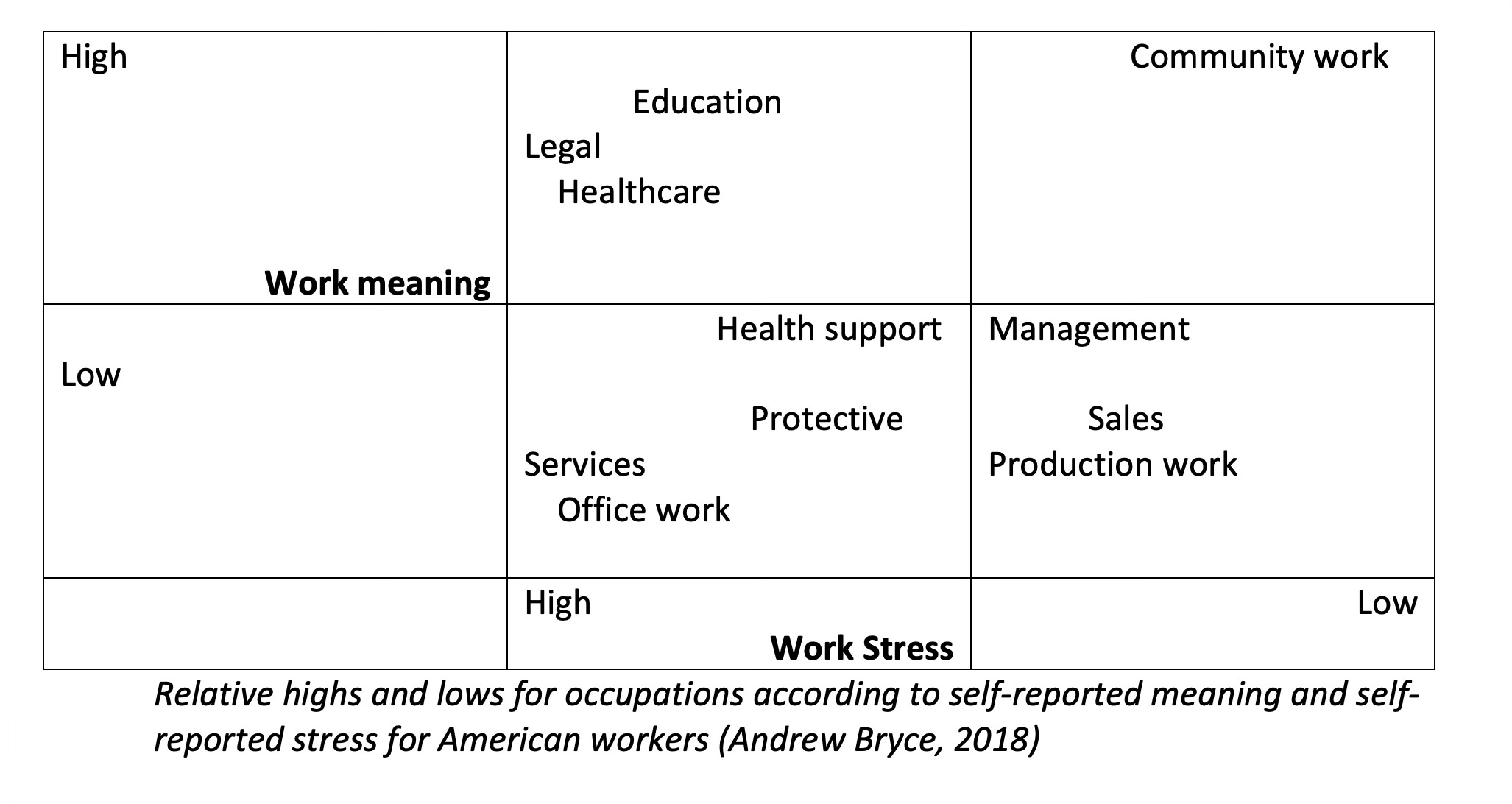
I have put some of these results in a matrix. The position of the occupations are relative, not an indication of absolute meaningfulness or of absolute levels of stress.
The intriguing result from Bryce’s analysis is that doing meaningful work is not a recipe for a stress-free work-life. The top left box shows occupations that were rated highly meaningful by workers. They also rated these occupations as relatively stressful.
In contrast, people doing community work have a work life that is low-stress and highly meaningful.
Health support people have less meaningful work and moderate levels of stress. Work life feels better for managers, those in sales and in protective services, but the level of meaningfulness they experience at work is moderate to low.
Overall, Bryce notes that jobs with a social, community focus (the helping professions) are rated as meaningful. Similarly, those where it is likely that the roles are more autonomous are rated more meaningful (health professionals vs health support for example).
People in meaningful but stressful jobs might benefit from some reflection on their “why” – the ultimate point of their work. Of course, this is no substitute for better design of work to enhance social connection, to increase positive emotions at work and to provide clarity and coherence in their work processes (taking note of Heintzelman and King’s review).
You have to appreciate that many people are both making a serious contribution and also doing tough jobs.
Great article Stewart and an important topic. Thanks for sharing your research and analysis.