

A delicious and healthy fruit salad; image from Dot Dash Meredith Food Studios
Is it too painful to change your behaviour in life-saving ways?
Is there a trade-off between maximum enjoyment now and a later longer life? Why not have a fun time, even if isn’t a long time?
Good news – it seems that we can enjoy the things that add to our longevity.
We’ll look at two examples – optimising sleep and enhancing exercise.
Jerry Morris and colleagues studied London busmen last century. While bus drivers sat, the conductors walked back and forth, and up and down the stairs of double-decker buses to collect fares. Which group lived longer?
In a 1961 study Morris controlled for the different “physique” (fatness) of these men in terms of the size of their uniform trousers. The result – controlling for waist size, was that the conductor’s mortality was about one-third that of drivers.
Modern studies, with massive cohorts have better designs, but the results are consistent. A 30-year follow-up of 116,221 US health workers who had completed regular reports on their activity levels found exercise reduced the risk of death by about one-third. The most effective weekly dose was a mix of 1.25 to 5 hours of “vigorous” activity (such as running, swimming or biking) and 2.5 to 10 hours of “moderate” weekly exercise (walking or weightlifting).
The consensus is that a mix of aerobic, strength and balance-promoting exercise does increase healthy life expectancy. But does exercise make you feel good?
Matthew Killingsworth and Dan Gilbert asked people to rate their happiness and note what they were doing (and how mindfully they were doing it) when prompted by their smartwatch. The second-most positively rated experience was “exercising”.
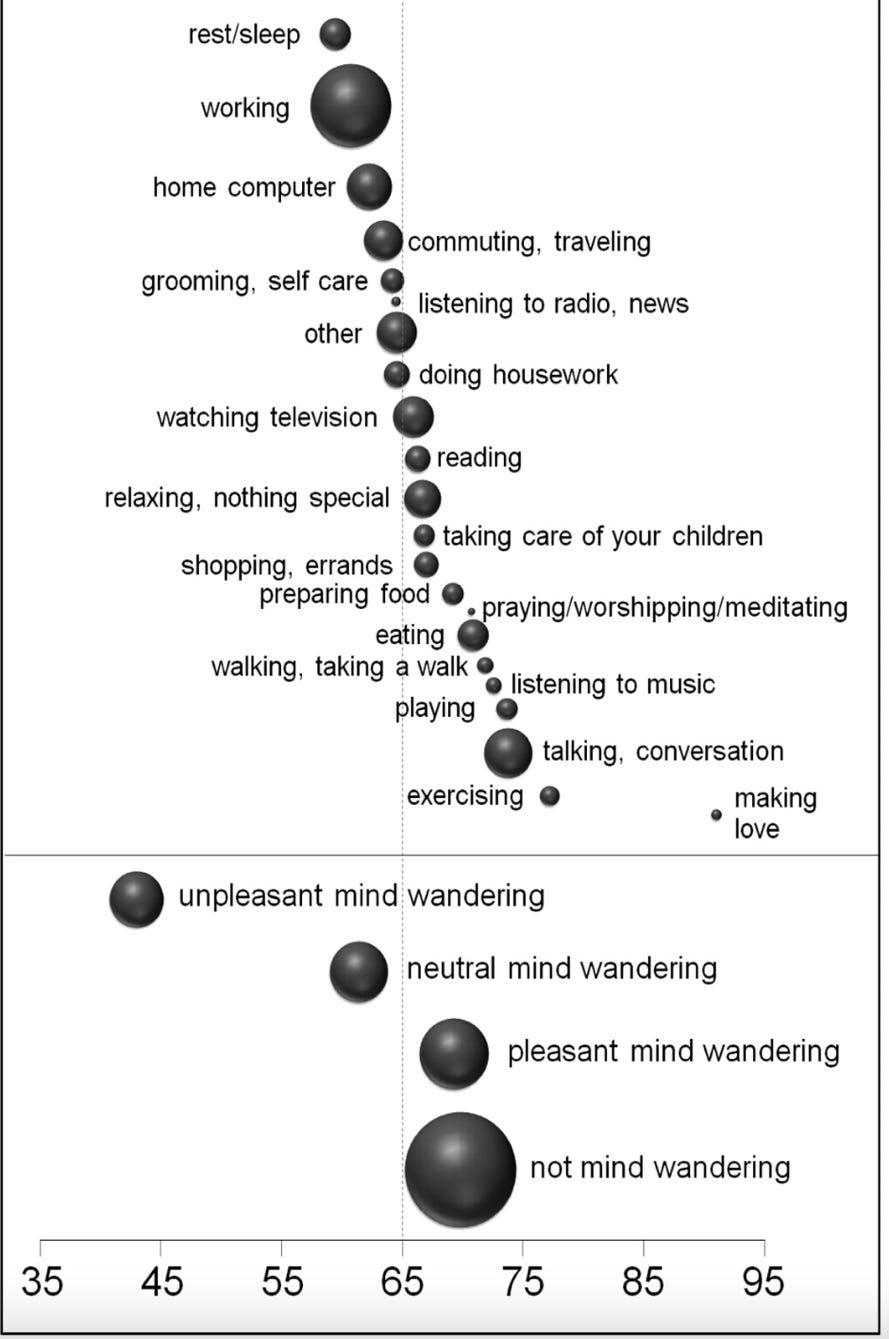
From Killingsworth & Gilbert, 2010
What about your sleep? Is a good night’s sleep good for both your health and your well-being? Sleep can now be measured accurately with “actigraphs” – expensive versions of the activity monitors in your phone. Following up a large group whose sleep had been measured in this way confirmed previous research which found a relationship between sleep and mortality.
Those who slept less than six hours a night were at the greatest risk of death (for example 29% higher for those getting 5 hours, and even higher for less). Good news for those who wake during the night – there was no relationship between sleep interruptions and mortality. And no difference in overall results due to sex or age differences.
The Killingsworth and Gilbert respondents (the chart above) rated their happiness as relatively low when sleeping and resting. Even lower than working (see the bubble at the top of the figure). A 2024 meta-analysis might help explain this.
Covering 154 studies and 5,717 individuals, Cara A Palmer and 6 fellow researchers concluded that sleep maintains optimal levels of positive affect. Sleep disruption reduces people’s ability to experience positive emotions. The opposite didn’t apply – sleep loss did not hugely increase negative emotions.
These researchers had an interesting evolutionary perspective on these results. Dealing with an existential threat (pulling an all-nighter to escape a serious threat such as a flood or fire, or to prepare for an exam perhaps) means pushing through and tolerating low levels of happiness. Positive affect, or the lack of it is not going to affect the chances of immediate survival.
Good sleep maintains the ability to experience positive emotions.
The smart-phone respondents in the Killingsworth and Gilbert experiment may have been a little low on positives before they slept. Getting the prompt from the phone when they wanted to sleep might have tapped into this low positivity.
Say you are part-way persuaded that optimum sleep and exercise will not only help you feel good but also increase your odds of living longer. You’ve got this right? But why do some others not take action to get these great results? The simplest explanation is they haven’t built up these healthy habits, yet.
A majestic study, a meta-analysis of multiple behaviour change meta-analyses suggests that for individuals the best approach to behaviour change is to build new habits.
That is creating automatic patterns of behaviour in response to a particular cue. Maybe it’s brushing your teeth after a meal. Putting on the seatbelt in the car. Responding “brilliant thanks” when asked how you are.
Habits are notable for their efficiency, lack of awareness, unintentionality and uncontrollability. Just what you need if you aim to get 7-8 hours sleep a night, or to average a combined 2.5 hours of moderate and vigorous exercise each day.
Books on forming habits are popular – I like Tiny Habits by B.J. Fogg – it’s chatty and approachable, and has the advantage of being based on science.
Phillippa Lally and colleagues studied what happened when people set out to learn a new habit (mostly eating, drinking or exercising habits). It took from 18 to 254 days before the behaviour became automatic – the median was 66 days.
I’ve used the Fogg ABC approach to help me build new habits – daily flossing being a recent example. My dental hygienist thought it was a good idea. But it took a deliberate ABC to make it happen.
A – the anchor – floss by the tap in the bathroom to trigger me each morning
B – the flossing behaviour
C – celebration – I then brush – with marvelous fresh minty toothpaste, yum!
New habits take time to become habitual. Choose the part of your life where you want to see positive change. While the habit is being established remember to notice the benefits of greater well-being.