Happy in your work?
Developing wellbeing

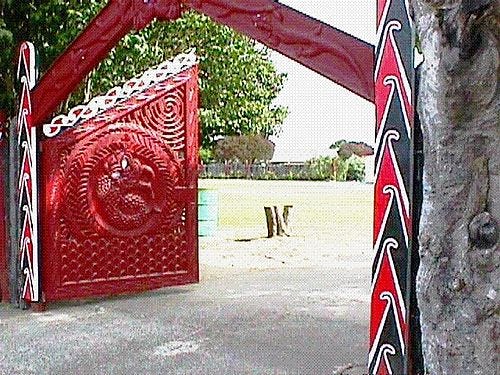
Image: Wikipedia: Ceremonial gates at Tūrangawaewae
Back last century, working on a management development project in beautiful Rabaul, Papua New Guinea I fielded a staff survey. Along with measuring job satisfaction (work engagement hadn’t been invented) we translated a New Zealand developed happiness scale into tok pisin (pidgin – the lingua franca of the country). It worked! The technical stuff stood up, and we demonstrated, just like the research then and since, that there is a connection between life satisfaction and work satisfaction. The correlation was .40 – or, on average, about 16% of life satisfaction is due to job satisfaction. And vice-versa.
This is usually discussed in terms of “spill-over”. Happiness in either domain can carry over. Because we are sense-making animals I think it’s less the level of happiness in our internal tank that we carry around from situation to situation. More the meaning we attach to what we are doing in different parts of our life.
If we see our work as meaningful, perhaps because we can see that it is a great match to the things that are important to us, then doing well in work is going to make us feel pretty good about life.
Anna Sutton at Waikato University has done some fascinating work on the role of perceived authenticity in work. One possible definition of authenticity is the fit we see between our true self and what we are doing in our world. Sutton has shown in a wide-ranging meta-analysis (75 samples, 36,533 people) that the perception of authenticity at work is reasonably predictive of job engagement (r=.37). The view of the alignment of our values and our work contributes to our immersion in and enthusiasm for the work.
Our view of our authenticity at work is also related to well-being (r=.40) – a construct with a wider range than job engagement – encompassing all the factors that result in the experience of life satisfaction.
If you lead people, you can help make the work more satisfying, and those folk happier if you lead a process to explore how this work contributes to outputs that are meaningful for your crew. For example, Te Puea Herangi inspired the work of her people to build the Mahinarangi meeting house at the Tūrangawaewae Marae in the 1930s. She explained the building work in terms of restoring the mana of the Tainui people. Not just clearing scrub or digging foundations but rebuilding their people’s place in the Waikato.