Happy together
How can we raise New Zealanders’ happiness?


Image: Variety.com
Happy people and happy communities do well. They are more innovative, compassionate and healthy. Is it possible to raise that happiness? First, we need to accurately measure happiness, such that an increase in the happiness index in a community, city or the country overall means that the people there are happier. Next, we need to research what contributes to more happiness, as well as identifying what produces more negative emotions.
For example, if increases in life expectancy go with increases in happiness (as it seems to), then working to increase life expectancy would be an end, together with being a means to the end of greater overall happiness.
In the latest United Nations World Happiness Survey (reporting on 2020 happiness), New Zealand makes the number 9 spot. That is a slight drop from making number 8 (in 2017-19). But we’re still in the top 10, right?
A slight diversion – for many 2020 was not a great year. The authors of the World Happiness Survey found that people were more likely (10% more likely) to say they had felt worried or sad, but that ‘positive affect’ had not changed overall.
Over the years 2006 to 2020, the period that the UN World Happiness series has been running, NZ has been slowly going backwards in our happiness ratings – from 88% to 85%.
Professor Robert MacCulloch of the University of Auckland thinks we can take the initiative and develop approaches to lift our happiness further.
MacCulloch also has some suggestions for how to do this. With colleague Rafael Di Tella he calculated how personal, social and economic factors make a difference to happiness. Looking down the 23-year period from 1975 to 1997 and across 11 European countries and the US (all members of the OECD), they measured how these factors effect happiness.
Three relatively large contributors were hours worked (more hours translates to less happiness), growth in GDP (more growth and more happiness) and the unemployment rate (as you’d expect – a higher rate means lower net happiness).
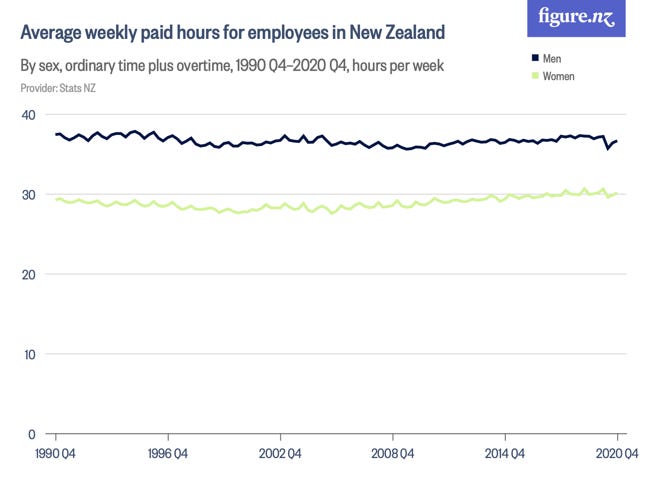
The chart (from figure.nz (https://figure.nz/chart/5kwujxp84PCE3k40) shows a long-term slight decrease in New Zealand men’s’ working hours since the 1990s. This is more than compensated for by a steady increase in the hours worked by women since 2002.
From the end of the last century New Zealand was rocked by a series of economic waves – the economic restructuring of the early 1990s, the bursting of the dotcom bubble in 2002 and the GFC meltdown of 2008. While bumpy, workers hours kept on their relatively high way. Kiwis in work kept on doing the hours.
If the OECD countries that MacCulloch and Di Tella used to develop their model are a guide – this overall high level of working hours is a weight on our happiness. This fits with a fascinating US study where people were regularly prompted by their smartphones to rate their happiness at that moment, and to describe what they were doing. ‘Work’ got the lowest happiness ratings. Sex was way out in front in terms of its highest position.
In another study, of unemployed or ‘economically inactive’ people in the United Kingdom returning to work, the minimum amount of work to produce positive emotions was between one and eight hours. Obviously when it comes to work you can get too much of a good thing. More hours does not result in more happiness. We look further at unemployment below.
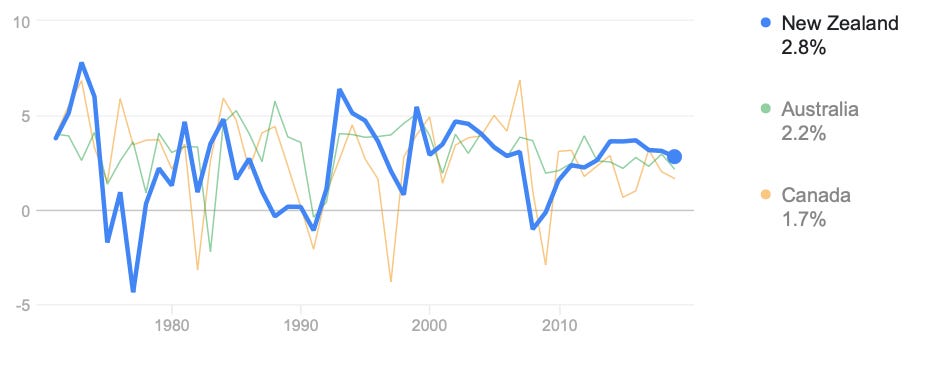
While Kiwi workers were doing those big hours – were they delivering more stuff? When we look at growth in GDP (the chart is from Google data), we don’t see a great story. If GDP growth contributes to happiness, until recently we’ve been jumping around without getting anywhere. GDP growth accelerated beyond 5% in the years immediately after Ruth Richardson’s 1991 Mother of Budgets. This growth level was not sustained. Growth has stayed between 2.6% and 3.6% in the 7 years from 2013 to 2019
Growth in New Zealand’s GDP, compared with Australia and Canada
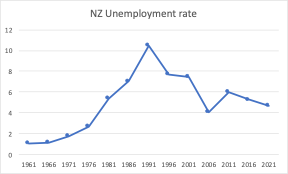
Unsurprisingly unemployment (Department of Statistics data, based on people actively looking for work as a percentage of the workforce) peaked in 1991, but has since been trending down.
Overall – if the OECD results translate to New Zealand, we have two downward forces acting on happiness – high working hours and low GDP growth. Unemployment is coming down – which could be pushing happiness up.
Just as MacCulloch and Di Tella identified what contributed to happiness across OECD countries it would be possible to highlight the drivers of happiness in New Zealand. For example, improving our working productivity would in theory reduce working hours or improve our GDP growth, or both. And there is plenty of potential to do that – we are an absolute laggard in terms of productivity.
It is obviously a great idea to lift happiness. Another way of looking at this is in minimising unhappiness. By not tracking and responding to how people are feeling we are at risk of the terrible social and political outcomes that we see in Northern England and rust-belt America. Workers out of work with little hope of finding meaningful alternatives experience negative emotions. And we see demagogues or wanna-be-demagogues who are keen to exploit those difficult emotions.
A shared commitment to increasing happiness (and reducing distress), including accountability for moving the happiness index would increase people’s trust that their country is committed to their wellbeing, not serving the interests of a few.
Stewart Forsyth is an organisational psychologist and executive coach and also the author of 21 Remarkable People – available from Amazon or Apple or other eBook sources.