Invasion:
The colonisation of the Waikato illustrates dark human traits, the 1995 Waikato Raupatu Claims Settlement Act illustrates a way to transcend such aggression

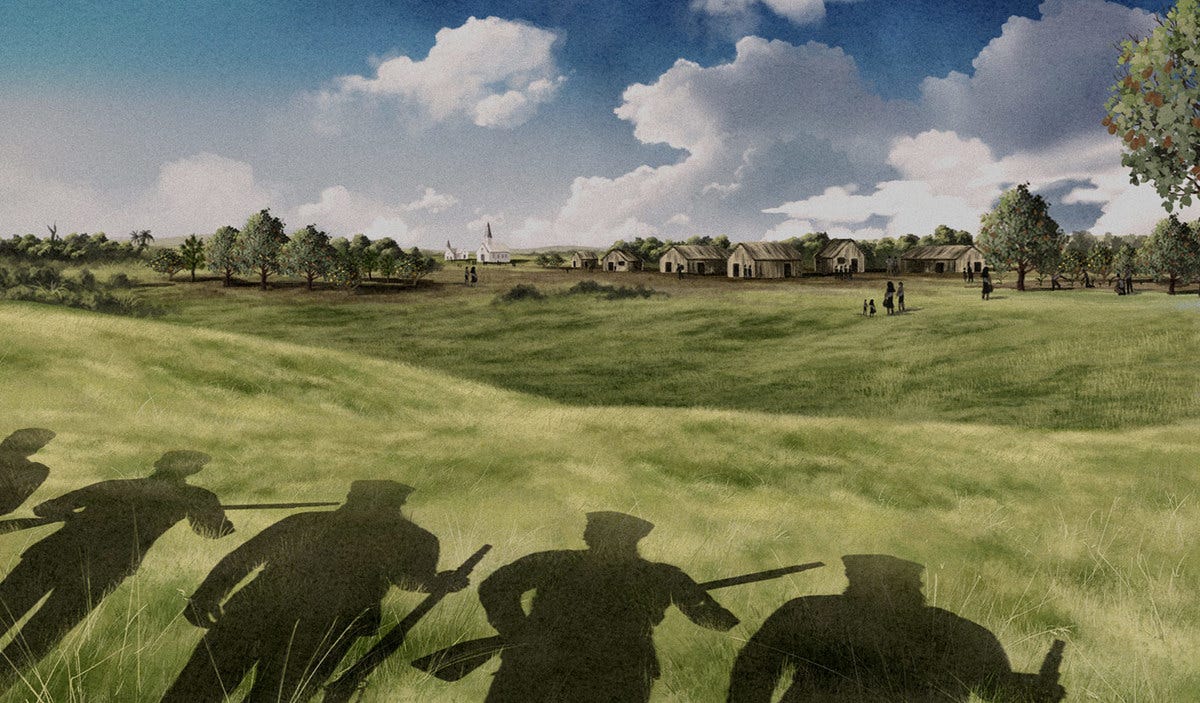
Image: From graphic novel of New Zealand Wars; Te Ara Wai: Journeys
The young soldier walked along the dark track. He was part of a long, silent column of troops marching through the night. They had crept past the enemy fortifications – less than a mile away he could hear the sentries calling the watch hours. But there were no shouts of alarm as the force of over 1,200 armed men had silently flanked past, heading for an alternative target.
The details of this story are from Vincent O’Malley’s comprehensive The Great War for New Zealand. The young soldier is likely to have been born in England, Ireland or Scotland and to have made his way to New Zealand in his 20s. He may have stopped in the Victorian goldfields. Many were recruited there, with the promise of land in the country they would be fighting in. More than half of these recruits were married, their wives and families following them and living in Auckland, while the soldiers went south to the Waikato.
As the soldiers marched through the night an older man slept in a local village. He was past the age of being a credible warrior. Since his birth in the early 1800s, he would have participated in a radical and wrenching reshaping of the existing tribal world. White traders exchanged muskets and ammunition for flax and other goods in the early decades of the 1800s. Northern tribes, with the advantage of muskets over weapons of wood and stone, conquered territory, exterminated some tribes, and took others captive to work as slaves producing more flax, and so bought more muskets. Vulnerable tribes rushed to secure their supply of muskets.
Waikato tribes expelled the Northern chief Te Rauparaha from Kawhia on the west coast. Then they invaded Taranaki – further south.
By the time the Treaty of Waitangi was signed (by Māori Rangatira or ‘chiefs’ and Governor Hobson, on behalf of Queen Victoria) in 1840 the “musket wars” – really a succession of battles, had been replaced with a new equilibrium, but with the loss of 20,000-40,000 people, at least 1/5 of the population. Historian Michael King called this a “holocaust”.
Pākehā started arriving in numbers. Missionaries introduced mission schools and there was a surge in literacy among the Māori – encouraging curiosity and understanding of the wider world. Māori understood that their Queen – Victoria – was looking after them as much as the settling whites.
The 1852 Constitution Act passed in Britain, the colonial power, gave voting rights and so political power to male property owners. No Māori had individual land title. Rangatira saw a threat to their authority and the risk of subjugation. The Māori Kīngi movement was established – an attempt at a unified response to the increasing power of Pākehā – Pōtatau Te Wherowhero was agreed as the first Māori King in 1856.
The people in the Waikato were rapid adopters. In a few decades, they established their reputation for agricultural initiative. In 1848 two young chiefs from Rangiaowhia village had cheekily sent a sack of flour to the British Queen – from wheat grown in their fields then ground in the village's water-powered mill. Queen Victoria sent two copies of a family portrait to New Zealand in recognition of their gift.
One of those portraits was in the local Roman Catholic church. It disappeared during the attack on Rangiaowhia, or its aftermath.
In the 1850s produce from the Waikato was traded to Auckland and the gold fields in California and Victoria. A census in 1852 counted 324 canoes crewed by 1,502 men and women bringing food and other goods from the Waikato to Auckland’s port of Onehunga.
Auckland was the prime market for Waikato produce. Te Wherowhero vowed to protect Auckland, the basis of the Waikato economy.
Carts from Rangiaowhia travelled the dray road to transport produce from the village to Te Rore (6 km north of Pirongia). At Te Rore goods were loaded onto coastal traders which sailed down the Waipā and on to Auckland. General Cameron’s force used this dray road for their final advance on Rangiaowhia.
Cash crops – wheat and sweet potato were growing in the warm summer of February 1864. Despite the war, the village should do well come to the autumn harvest. Village reserves of pigs, vegetables and potatoes would have gone to feed the hundreds of warriors who had thrown up the defences and were now prepared to defend them.
The villagers of Rangiaowhia believed that, although the invaders were close, they had guaranteed their safety as non-combatants – old men, women and children. And they were reassured by the impressive nearby line of defence. The Kīngitanga had the advantage of excellent military engineering. The musket wars had been devasting, but the design of pā had evolved in response to the threat of firearms. The Pāterangi line of defensive pās was a sophisticated structure.
The soldier arrived in sight of the village just after sunrise. He formed up for attack with his platoon. Their force of over 1,200 included cavalry, Forest Rangers, and soldiers.
It is estimated that there were about 100 women and children and 100 mostly older men in Rangiaowhia village.
The old man would have heard the sounds of the attack – the clatter of the horses as they galloped in, the shouts of the troops. The shots, the screams of women and children.
There were seven others and some muskets in the grass hut he was in. They fired at the invading forces; the walls provided limited protection but made it harder for the attackers to target them.
Perhaps it was a muzzle flash, or a deliberate effort by the attackers, but the hut caught fire. The summer-dried grass burned quickly, inside the smoke would have been choking.
The old man grabbed a white sheet, wrapped it around him as some protection from the flaming strands of grass falling from the roof, and made it out the door to face the invaders.
He was not armed and held out his empty hands.
The young man stood with other soldiers, in rank, firing into the flames engulfing the hut. Then he saw the figure in white, in the smoke, standing looking at him. The other soldiers targeted the old man. The young soldier joined the firing.
The old man died where he fell. Those in the hut stayed and died there.
General Cameron’s attack on the village of Rangiaowhia blind-sided the forces in the four-pā Pāterangi line – the third, and ultimately the final line of defence. The Kīngitanga warriors (‘Kingites’) fought a retreat, taking weapons, and ammunition, ensuring the safety of warriors and of those who had survived the initial attack on the village, leaving behind crops and rich land.
Historian James Belich considers this Cameron’s greatest victory. He did not annihilate the Kīngitanga – the 2,000 warriors from a constellation of tribes who manned the Pāterangi line. But they had lost the area from which to mount any future attack.
Belich describes what the Māori forces were up against. Cameron’s force was 170 km from Auckland – the source of much of the requirements of his force. He had committed many of his troops to protect communication and supply lines. Cameron still fielded 3,000 troops to stake out Pāterangi and attack Rangiaowhia.
The Kīngitanga had to balance two priorities. As well as fighting the invaders, these warriors needed to spend time in their villages – contributing to crop growing and harvesting and ensuring the safety of their people.
Cameron had the advantage invaders have had many times in human history. His invading force is predominantly young males. They have to be fed and provisioned, but they are unencumbered. They only have to attack the defenders. The defensive force needs to engage with the enemy, and also ensure that women, children and resources are protected.
Cameron’s surprise flanking attack on the undefended village illustrates this vulnerability.
Young males at the front of an invading force have less to lose; they have no more resources than they can carry. That is a part of the reason for them being at the sharp end of the invasion. Over many generations, young men have headed out from the established area to secure resources sufficient to establish and support a family.
It is not a coincidence that young males are more risk-tolerant. Roy Baumeister outlines the evidence in his book Is There Anything Good About Men? The equation many have faced in the past is between slim pickings if they stick around and the chance of getting lucky if they strike out. Those that do better will marry and pass on their genes – so inclining future generations of males to see the positives of moving out.
How did the dynamic change from profitable trading between settlers in Auckland and Waikato tribes in the 1850s to invasion by British and Colonial forces in 1863-1864?
Anthropologist Polly Wiessner studies war in small-scale societies. When new populations move into already settled territory she distinguishes the choice between trading or colonising. Trade involves the recognition of the value of the goods and the humanity of others.
Invading colonisers dehumanise the people they aim to subjugate or replace. The Victorian settlers assumed that they would replace the “natives”. Historian Ross Galbreath: “The British colonists arriving in New Zealand came armed with the expectation that all the native life — plants, animals and people alike — would inevitably be supplanted and displaced.”
Governor Grey’s private secretary Edward Shortland visited south Waikato in 1842. Near Rangiaowhia he saw cornfields more than a mile long; “the most lovely I have yet seen in New Zealand.” As well as their beauty perhaps he saw proof of the value of replacing traditional crops, and also the inevitability of the displacement of the local farmers and their families.
Perhaps it was as simple as the rapidly rising numbers of Pākehā and their expectation of land that tipped the relationship between Māori and Pākehā from trading to a war of colonisation. The ideology of white supremacy and the right to recreate the country to match a European ideal reinforced colonization.
For Māori, the loss of land represented their future subjugation. The evidence indicates that human invaders kill existing inhabitants and push those remaining down to the bottom of the new social order. The arrival of farmers in Europe over 6,500 years ago displaced the resident bands of hunter-gatherers. There is genetic evidence that those with hunter-gatherer genes ended up at the bottom of the hierarchy that came with agriculture.
In his book Belonging, Owen Eastwood (Ngai Tahu) notes that after the New Zealand Wars Māori were at the bottom of a social hierarchy, with the English on top and Scots and Irish below them but keen to ensure they sank no lower. Without land, the Waikato Māori became agricultural labourers.
Over 100 years later Peter Davis and other researchers at the Department of Statistics were developing a measure of socioeconomic status. Table 2.9 of their monograph reports occupations in terms of ethnicity. Māori were under-represented in the top socioeconomic status jobs of professionals and managers. They were more than twice as likely (2.7 times) as non-Māori to be in “operator” or “elementary” jobs – at the bottom of the occupational hierarchy.
A contemporary newspaper report of the attack on Rangiaowhia (4 March 1864, Otago Daily Times) left out details of the deaths of women and children, and the murder of a man attempting to surrender, it concluded:
“The most serious result to the natives by the occupation of this portion of the country is, that in it are situated the greater part of the cultivations. Hundreds of acres of maize, wheat, and potatoes, peach gardens, melon grounds, and orchards are now in the hands of the troops.”
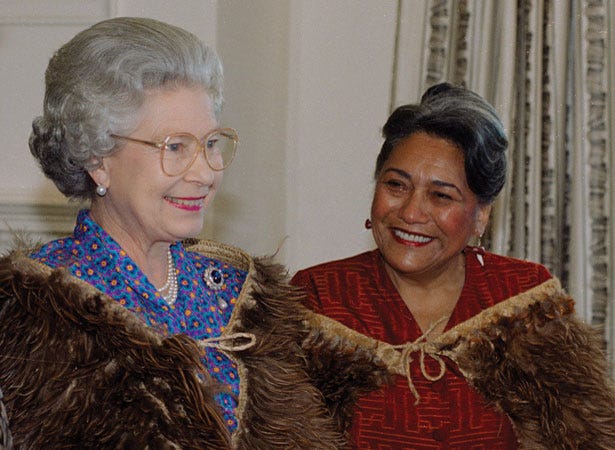
Image: Queen Elizabeth and Māori Queen Dame Te Atairangikaahu, 1995
When Queen Elizabeth signed the Waikato Raupatu Claims Settlement Act into law in 1995 she demonstrated an aspect of New Zealand’s present approach to conflict resolution. The Act, including the apology by the Crown for the unlawful invasion and later confiscation of Waikato land, represents the outcome of negotiations between representatives of the crown and Tainui, informed by the findings of the Waitangi Tribunal.
This settlement and more like it illustrates a shift in view from overwhelming and supplanting the Tangata Whenua to working together to resolve problems and recognize the value that each party to the relationship can bring.
Stewart Forsyth is an organisational psychologist and executive coach and also the author of a weekly blog on the practical aspects of psychology -
For references mentioned – email stewart@fxc.co.nz