Keeping the vax bus going
Ensuring a sustainable approach to positive health behaviours

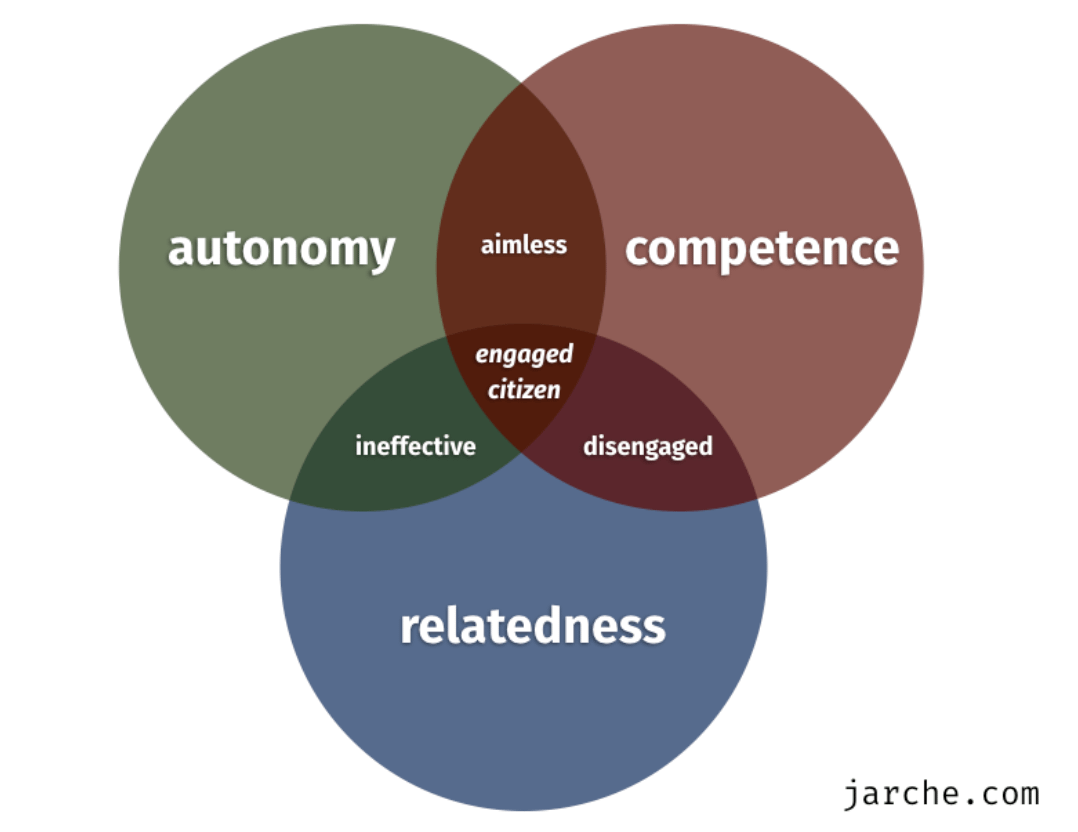
Image: jarche.com
All across the motu people are jumping on the bus, literally and figuratively, to get their vaccinations.
Part of the motivation is the painful re-acquaintance with lock-downs, and the desire to stop that happening again. However, as coach Yogi Berra said, “It ain’t over till it's over.”
Taking on the vaccination challenge is exciting, but how do we ensure that Team Auckland (and the rest of Team New Zealand) don’t run out of puff?
In the long game, there is the next infectious disease. That could be another variant. Or ‘just’ next year’s flu (which kills 500 New Zealanders a year).
The approach taken now could get us to our present vaccination goal and encourage other healthy behaviours such as masking as well as future vaccinations.
There is good research indicating how we help people achieve that sustained motivation. ‘Self-determination theory’ works from three fundamentals of human motivation to promote change, including healthy behaviours. The three areas are competence – the person believes they can do this; relatedness – relationships that support change – such as respectful communications with health providers; and autonomy – making choices for themselves – the ‘self-determination’ piece. An analysis of 73 randomized controlled trials (the scientific ‘gold standard’) demonstrated that working with these needs resulted in sustained behaviour change in areas such as exercising, stopping smoking and taking medication. That didn’t include getting vaccinations – but the range of applications covered indicates the approach should generalize.
How to apply this to motivate New Zealanders to go for vaccination now and in the future? Are people able to take action? For example, is it as easy as getting to the bus in their street? Does their social system – especially family and significant others – support it? Does getting the vaccine match their core values and beliefs? For most of us that would be the protection of loved ones.
Change in the first area can be helped with ‘nudges’ – it’s easier to do it than not do it. Going through tricky websites to make a booking, getting transport (and parking!), arranging the care of dependents – all of that makes it easier not to do it. Having the needles within easy walking distance, along with advertising their availability makes a positive difference.
On the social side – a key ingredient is the advice people get from trusted authorities. Research in New Zealand (and abroad) is that those vulnerable to conspiracy thinking do not trust scientists. We’re not talking about the actual conspiracy mouthpieces here. Our concern is those who see some ludicrous story about what’s in the vaccine pop up in their newsfeed. Read on, or even share? Or scroll away from these dubious facts? That depends to a large extent on whether their influencers tell them that this is rubbish. Or not. A big part of success in this ongoing battle is going to be influencing the Influencers. Inoculating these central players with facts as well as the vaccine.
The scientists can help prepare the talking points even if they are not always going to be effective as influencers.
The flip side to this is the need to call out those spreading lies. Attacking people is not the way to change minds and build motivation for healthy behaviours. But making people in leadership roles accountable if they push mistruths is crucial. Anyone who holds a leadership role – in their work, in the community, as a professional – assumes accountability for telling the truth. Professional bodies must contribute. If the professional can’t point to the research evidence to substantiate a claim (for example to not get vaccinated if you are pregnant) then that’s not professional. This provides the basis for all of us to judge the value of information. When a president pushes hydroxychloroquine as a cure for Covid-19, we can check the evidence, and call that out if it's crap.
There is potential here for online resources – featuring diverse authorities – which can be shared as easily as a tweet from Nicky Minaj (promoter of the swollen testicles meme).
A key part of motivating sustainable health behaviour is internalizing the value of the new approach. If I’m forced to eat rats, I’m not likely to do that again if you’re not around to make me. If you help me see some profound value of putting rats on the dinner table, then that might become part of my diet. Especially if they are battered and deep-fried.
Those who feel forced to get the jab are more likely to push back. And are less likely to get on board next time.
How would some initiatives in play, or which could appear play out?
Financial incentives – if these are seen as the reason I’m doing this, then they are only going to be good for the here and now. I’m not going to do anything like this next time off my own bat. It could be possible to frame these as less a reward for good behaviour and more an example of positive support. To defray hassle factors (such as to pay for a taxi) or facilitating some celebration (selfies featuring pies and chips as well as bared arms).
Vaccination passports. Do I need one to join my mates in the bar or event? That doesn’t mean I’ll rush off next year to get a different vaccine for a new threat. If I buy into the idea that this means I am looking out for my mates, or the others at the venue, including help-staff, then this is likely to connect with my internalized motivation – if that includes wanting to protect others as well as myself.
The vaccination push is our greatest present challenge and will provide the opportunity for us to continue to look out for each other.
Stewart Forsyth is an organisational psychologist and executive coach and also the author of 21 Remarkable People – available from Amazon or Apple or other eBook sources.