King D
The danger of unchecked narcissism

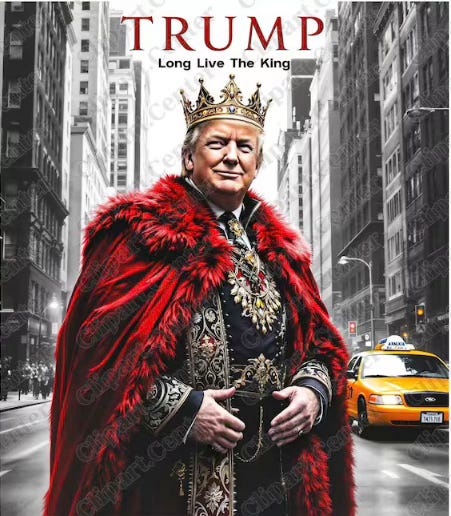
Image: etsy.com
In 1531 the 22-year-old King of England invaded France. This campaign is estimated to have cost nearly one million pounds (about 11% of England’s GDP at this time) for the capture of two not especially significant towns (described by some of his subjects as “graceless dogholes”, quotes are from historian Alison Weir). But this did provide an opportunity for much celebration of the prowess of the new king - Henry the VIII.
The present attack on Iran has so far cost the US $890m a day. That is an annualised amount of around 1.1% of the GDP of the US. The success of this war is difficult to assess, since there is no clear articulation of the goals of this effort. Possibly part of the reason is to assert the prowess of President Donald Trump.
Both adventures are evidence of the disturbed personalities of Henry VIII and of Donald Trump.
While diagnosis from a distance is difficult, there is a theme of grandiosity and boldness in the behaviour of these two men. They are similar in being reward-driven, capable of doing whatever it takes to achieve those rewards, including the exploitation of others. Both demonstrate an exhibitionistic style, attempting to promote their self-importance. This fits with modern views of grandiose narcissism, where a range of extreme behaviours emerge from a core of self-important entitlement.
Origins
Both were born into privilege. Both learned early that they were special. While not the heir in his early childhood Henry was talented at music and sports. He would have been the centre of admiration. He would not have been punished for misbehaviour – the “whipping boy” was a real person.
Fred Trump was a successful real estate developer. He drove a Cadillac, his wife (Mary-Anne) a Rolls-Royce. Donald Trump describes his father as a “tough mentor” and the “most important influence” on him.
In her biography of Trump (Too Much And Never Enough), his niece, clinical psychologist Mary Trump reports that Fred Trump favoured Donald over his elder brother.
In a research report by Eddie Brummelman (in PNAS) the early experience of being treated as more special and more entitled than others is frequent in the childhood of those who are later defined as Narcissistic.
Core of entitlement
From the age of 18 Henry was the king. Tournaments, banquets, even invasions of France were his to order. He is infamous for his use of women, particularly discarding those who didn’t deliver a male heir. Less well known perhaps was his elimination of those he saw as possible threats. Historians estimate that some 57,000 protestors were executed.
In July 2025 the One Big Beautiful Budget Bill included US$75 billion for the Immigration and Customs Enforcement (ICE) force. This was on top of US$10b base funding for ICE. That’s around 10% of the $US$850b funding for the US Defence Force, and more, for example, than funding for the Marines. This has provided Trump with a force that has been employed particularly against democratic states who have protested Trump’s actions.
Self-promotion
Both men need to promote their special qualities.
Lorenzo Pasqualigo, the Venetian Ambassador attended a 1515 pageant which featured the mythical Robin Hood and his archers. Pasqualigo describes being quizzed by the 24-year-old Henry about the height, stoutness and the legs of Francis. When told that the French king’s legs were “spare” or thin, Henry opened his doublet (an overshirt, often worn under a formal robe) and slapping his thigh said “look here! I have a good calf to my leg”.
In tweets during 2018 Trump wrote that “throughout my life, my two greatest assets have been mental stability and being, like, really smart,” citing his success as a businessman, television star, and his 2016 election win on his “first try”.
Whatever it takes to get to the goal
In their pursuit of personal goals rules are no obstacle. Nor concern for the well-being of others.
Chief Minister Thomas Cromwell (no relation to Oliver) ensured Henry’s divorce from Catherine. Cromwell then enabled the English Reformation after England ended its religious ties to Rome. He was Chief Minister from 1534 to 1540. After which he was beheaded.
Potential wife Christina, Duchess of Milan had the measure of Henry when she wrote, responding to being sounded out about her eligibility for marriage: “The King’s majesty was in so little space rid of the queens that she dare not trust his Council, though she durst trust his Majesty.”
A New York jury convicted Trump on May 30, 2024 of 34 felony counts of falsifying business records as well as concealing hush‑money payments and disguising them in company ledgers
Trump revels in notoriety, including for the exploitation of others, including his statement in the 2008 Access Hollywood tape: “Grab ‘em by the pussy. You can do anything”.
Desperately dangerous
In a 2015 survey, historical writers voted their choice of the “worst” English kings. Henry VIII came out on top. Robert Wilton, the author of The Spider of Sarajevo, called the Tudor king “a gross man-child, wilfully and capriciously dangerous to everything around him including the country.”
The attack on Iran increasingly looks like the epitome of capricious – with dangerous consequences.
When dealing with someone as self-entitled as Trump there is a logic in keeping your head down rather than losing it.
New Zealand’s mild response to the attacks on Iran can be seen as being realistic in this context. The other suggestion in dealing with a powerful narcissist is to build a credible alliance. This is being promoted by Mark Carney, Canada’s Prime Minister, as he attempts to rally other middle powers. Are we doing some quiet talking with these potential allies?