Kupe
Charismatic Leader

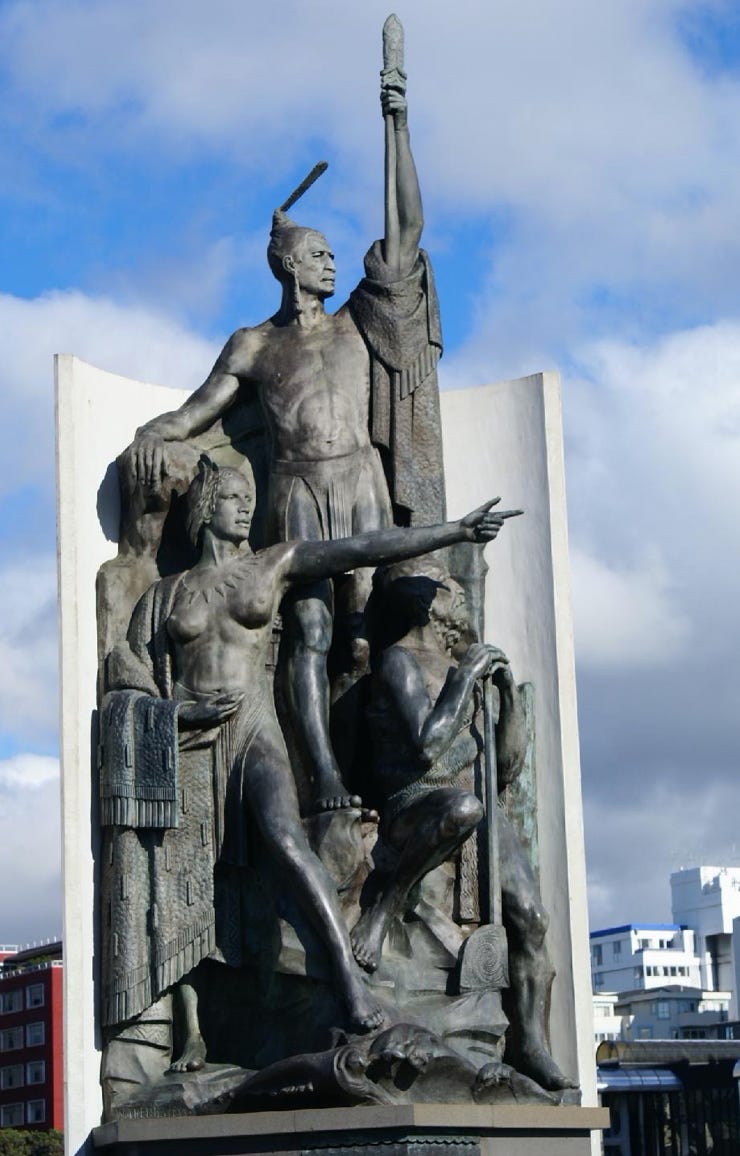
It takes charisma to get people on board the waka for a perilous journey to an unknown destination. Kupe (and other leaders on other wakas) would have had such inspirational charisma to achieve the voyage to Aotearoa over 750 years ago. Throughout our history, charismatic leaders with a blend of positive extroversion and emotional steadiness have guided such initiatives. Modern research indicates that leaders who champion innovation and change profile in the same way.
About 750 years ago, on a little island at the north end of Te Wai Pounamu (the South Island) – people gathered to manufacture stone tools, exchange resources, and of course, eat. They could be described as following the ‘see food (and eat it) diet’ – many different animals went into the hangi and the remains into the middens. (Including mussels, pipi, paua and cockles, four species of moa, moa eggs, whale, seals, dolphins, eels, skates, sunfish, sharks, Haast’s eagle, Eyles’ harrier, New Zealand swan, New Zealand raven, kuri, tuatara and kiore.)
These people were new arrivals in Aotearoa (‘land of the long white cloud’, or New Zealand), inspired, according to a range of stories, by the legendary navigator Kupe – the first visitor to Aotearoa. Accompanied by Ngaki (or Ngahue) in another canoe, Kupe found the land (according to one story) while chasing an octopus. His legacy lives on in the names of islands and land around Te Moana-o-Raukawa (Cook Strait) and the Hokianga. Kupe can still be seen – surveying Te Whanganui-a-Tara (Wellington Harbour) from the waterfront, along with his wife Kuramārōtini(who, noting the clouds above the land, gave us the name of our country).
It is difficult to describe such a legendary figure, especially one who is the subject of so many stories passed down so many generations. But we can make some reasonable assumptions about Kupe – based on what we know about the people who gathered at what we now know as Te Pokohiwi (the Wairau Bar, which later subsumed the island).
The peopling of the Pacific by the Polynesians represents the final and most ambitious thrust of human colonisation in terms of distances covered – from the Tongan and Samoan island groups north to Hawaii (4,000 km), east to Rapanui (Easter Island, and on to the coast of South and Central America; respectively over 6,000 km, and then another 4,000 km) and south to Aotearoa (over 2,000 km to Hawaiki – the island group spanning Tahiti and the Cook Islands, and then more than 4,000 km for the final leap to Aotearoa). Professor Lisa Matisoo-Smith of Otago University provides startling evidence for the nature of this first colonisation.
Matisoo-Smith, working from mitochondrial DNA (passed down through the women’s line) collected from burials at Te Pokohiwi, estimates that there would have been a few hundred women in this, the earliest settlement of New Zealand yet studied. And where there are women (and food) there would also be men and children. That suggests mass migration in many twin-hulled ocean-going waka, sailing purposefully down from many locations in East Polynesia, known collectively as Hawaiki.
Building a twin-hulled, ocean-going waka is a significant enterprise. Stocking it with provisions for the journey, and with the plants and animals to establish a settlement in the new land is also a big job. But perhaps the toughest job is persuading men, women and children to get on board and head south-west. Kupe would have had his work cut out – pitching the story of the new land rich in resources, but over the horizon. Certainly, there were clues that he was right – the birds that flew southwest from the islands of Hawaiki had to go somewhere. But there was the very real chance that these voyagers would miss the new land, or be sunk by storms, or attacked by dangerous sea creatures.
As Richard Walter (Otago University) and colleagues write – communicating the wonder and opportunity of this enterprise would have taken remarkable leadership: ‘individuals of extraordinary charisma, mana (authority) and ability to draw on deep-seated Polynesian traditions and structures to recruit others into their vision.’
Charismatic
Leaders of such disruptive initiatives have a unique mix of traits. The qualities that inspire a break with tradition are not what makes for success during business as usual. Inspiring mass migration is very different from encouraging planting, fishing, paying dues to the elite and placating the gods. These activities are seasonal and predictable while sailing to a new world provides the opportunity for a new approach in a new country.
The modern analogy would be the radical changes in behaviour required to respond to the climate (and environmental) emergency. In a business, the analogy would be the need to pivot in response to a move by a competitor, the arrival of new technology, the stresses imposed by a pandemic, or all of these to survive and be positioned for future opportunities.
The evidence indicates that the leaders who inspire and energise change are more likely to have a Charismatic personality style. What shapes that personality? And how do the leadership behaviours of such Charismatics help their people make the change?
We will answer these questions with an illustrative example, and then the ‘meta-analyses’ – the reviews which statistically combine large numbers of studies, demonstrating the substance of these results.
In a study of the leaders identified by their followers as charismatic; staff ratings of their managers’ charismatic leadership were related to how the managers assessed themselves in terms of a mix of both high extroversion and low nervousness. Fast forward 15 years, these initial personality self-ratings predicted the managers’ later income, number of subordinates, and (higher) level in the hierarchy.
This was not a chance result. A meta-analysis of 26 studies indicates this combination of extroversion and emotional steadiness is indeed related to charismatic leadership (defined in terms of ‘idealised influence’ and ‘inspirational motivation’).
It does seem that ‘extroversion minus nervousness’ contributes to a leader’s charisma. How about the ability of Charismatic Leaders to inspire and motivate change?
An illustrative example of the role of such leaders is a study across teams in an Australian research institution. Teams led by Charismatic Leaders were rated as more innovative. In a comprehensive review of 112 studies across 31 countries (including New Zealand), the two highest impact leadership styles were – ‘organisational visioning’ and ‘motivational communication’. That is – visionary leaders were able to ‘depict a future that is credible, realistic, attractive, inspiring and better than the status quo. These leaders expressed ‘positive and encouraging messages about the organisation that builds motivation and confidence.’
It is a long shot to guess how leaders in Hawaiki 750 years ago were inspiring people to build, provision and get on board the wakas. But it is likely that as a group they would have been extroverted and emotionally stable.
Extroversion would contribute to their articulation of the vision of an incredibly rich new land, while emotional stability (the inverse of nervousness) would have been useful in downplaying the personal risks involved. Extroversion would energise the drive to make this radical move while low nervousness would have prevented being knocked off course by the challenges of this amazing but dangerous venture.
Extroversion is related to migration. Or rather, the genes associated with novelty-seeking (a facet of extroversion) are more prevalent the further out of Africa human populations have moved. It seems that aspects of extroversion such as exploratory behaviour, novelty-seeking, and risk-taking are more common in those taking the lead in migration.
If you are a present-day Charismatic Leader, aspiring to support groups making radical change – what can you do to achieve an ongoing, sustainable contribution?
Does the current endeavour have a future? Are you promoting an illusion? it is vital to understand the context, the issues, and as much of the complexities as is possible to get to know. You need all the evidence you can get hold of. Are you informed by a source as credible as Kupe? And do you have a reality check on that story? The equivalent of Kupe’s buddy Ngaki who can corroborate the story.
If you are inspired to follow a Charismatic Leader, you need to be aware of their inclination to see opportunities as positive and their bias to action. The cost-benefit calculations they make might have more positive assumptions for the upside and fewer concerns about the downside than you would allow. What works for the Charismatic Leader might not compute for you.
The leaders who navigated waka from Hawaiki had the key responsibility of getting their people to their new land. Probably some onboard felt sea-sick or home-sick, but individual needs or goals had to be bent to the group objectives. To get technical about this, Charismatic leaders are better at motivating group results than the outputs of individuals. An important consideration before you follow where the Charismatic Leader is going is the extent that your goals fit with the goals the leader is outlining for the team. Is heading over the horizon to a new land meaningful enough for you to put up with the hardships involved?
Kupe and his contemporaries were possibly inspired by Polynesian folk hero Māui. Sailing out of sight of land for weeks it would have been comforting to know that Māui, who is credited with fishing habitable islands up out of the sea, had previously shown the Polynesian people (and their ancestors) the way east (and north and south). The stories about him can be traced back to the islands north of Papua New Guinea, and describe a larger than life character who was exuberant, fun and thrill-seeking. A good role model for the Charismatic Leader of change and innovation.
Stewart Forsyth is an organisational psychologist and executive coach and also the author of 21 Remarkable People – available from Amazon or Apple or other eBook sources.