Leadership lessons from human evolution

“… say that a man has been hunting. He must not come home and announce like a braggart, ‘I have killed a big one in the bush!’ He must first sit down in silence until I or someone else comes up to his fire and asks, ‘What did you see today?’ He replies quietly, ‘Ah, I’m no good for hunting. I saw nothing at all … maybe just a tiny one.’ Then I smile to myself because I now know he has killed something big.” (Richard Lee, recounting a story from an !Kung informant.)
Our evolutionary history inclines us to behave socially in terms of the solutions developed by small groups of hominids over thousands of years. What does this imply about leading people well?
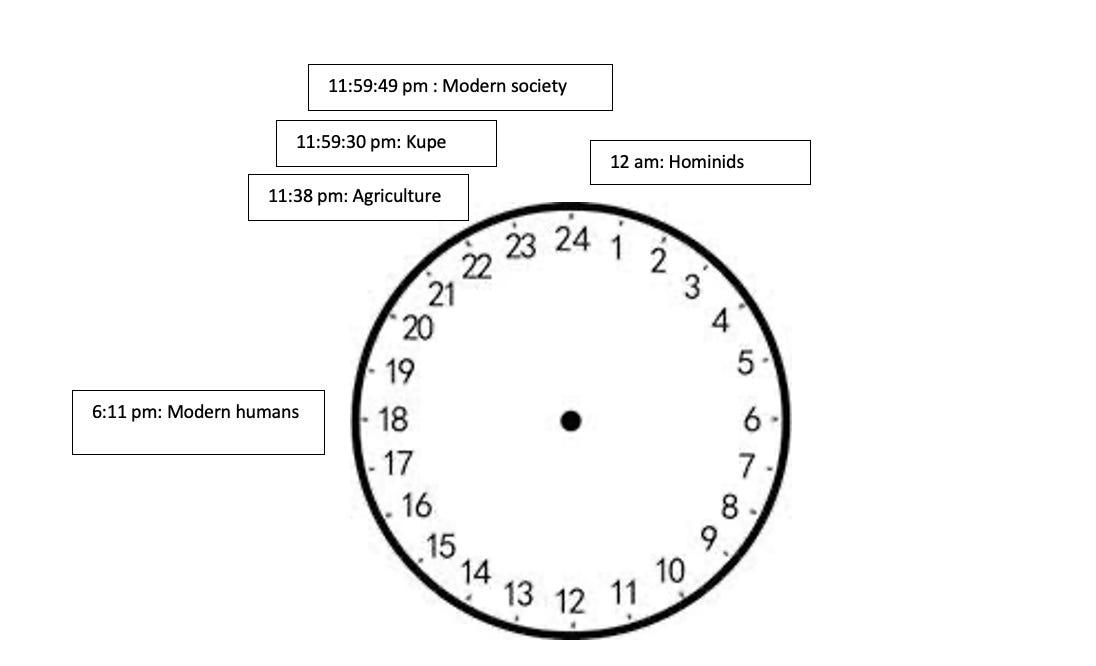
The clock (below) shows the time scale of human evolution. Groups of hominids were on the scene from about 2.5 million years ago. If we started a 24-hour clock then, it would have been past 6 pm that night that modern humans emerged. The agricultural revolutions kicked off at 22 minutes to midnight – humans began to live in bigger and bigger groups and we see the emergence of cities in the archaeological record.
Humans had colonized every significant landmass in the last minute before midnight, marked by the arrival of Kupe and others in Aotearoa / New Zealand. 11 seconds before the bewitching hour – 250 years ago – nation-states and democracies kicked off.
The political and business leaders of today didn’t invent leadership in the last few moments of our human evolution – they work with the raw material inherited from this evolutionary history.
When people face challenges that involve the coordination of the skills and knowledge of others – such as preparing waka for a multi-day open water trip from Hawaiki to New Zealand or launching a multi-channel marketing campaign – they are likely to solve these problems in very similar ways.
For example, task leaders emerge when a project is being set up and roles and expectations need to be made clear. People or social leaders assume greater importance when the group needs help to resolve interpersonal issues or maintain motivation and commitment.
If there is a crisis, such as the threat of another competing group, a sudden technological glitch or a pandemic, we are likely to look for a leader, and those who can respond quickly are more likely to assume that role – that is why extroversion (comprising assertiveness and boldness) tends to be seen in leaders.
If there is not a crisis, and people both understand what they need to do and have the skills to do that, leadership is counter-productive. Team results drop if there is a micro-managing leader. Modern companies with a highly skilled workforce have wrestled with the issue of management. Do modern businesses need managers?
In 2002 Google did away with all managers. It didn’t work. This being Google they researched how good managers added value. Their research identified the 10 behaviours of managers that contributed to high performing teams (there were originally eight, but more work elaborated on that).
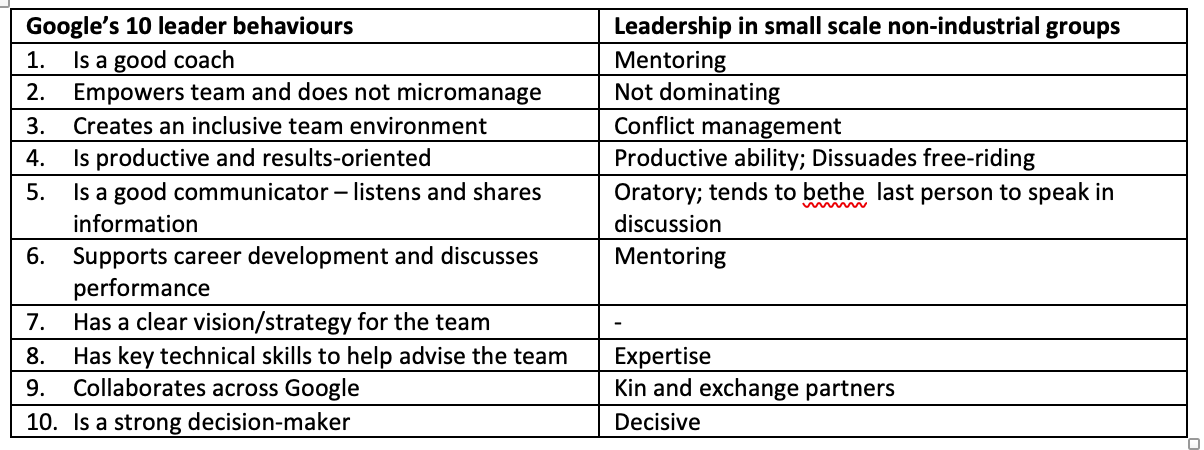
In the table (below), I have matched Google’s 10 leadership desiderata with systematic studies of what leadership looks like in small scale societies. This is based on two detailed studies – of the forest-dwelling Chabu hunter-gatherers in Ethiopia and the Tismane – forager horticulturalists in Bolivia (Zachary Garfield and Edward Hagen researched the Chabu and Christopher von Rueden and others the Tismane). Garfield’s team also looked at female leaders – who were the equals of men in situations where expertise mattered.
There is a good match between what works in a high performing modern business and what works in smaller-scale societies. It is important to note that leaders emerge in these small scale societies. These people are the ones best suited to take charge in that particular context. That means the long-range vision or strategy doesn’t apply.
Of significance in both of these studies was the importance of allies. This alliance-building is probably under-emphasised in modern organisations.
We are not using the hunter-gatherer results as a model of some ideal, utopian way of living or leading. We are seeing in these societies time-tested evidence of what works. Life as a hunter-gatherer world was not elysian. It was violent and there was a high death rate. That was not just predation and conflict with other bands, also murder within the group, even of dominating alpha males.
What has worked and works now in this environment has worked for a very long time. It gives us strong indications of what can work for modern leaders in a challenging world.
Stewart Forsyth is an organisational psychologist and executive coach and also the author of 21 Remarkable People – available from Amazon or Apple or other eBook sources.

Image from National Geographic