Leading climate action
Leaders who are looking for the evidence of what works, not looking back to find a precedent achieve climate action

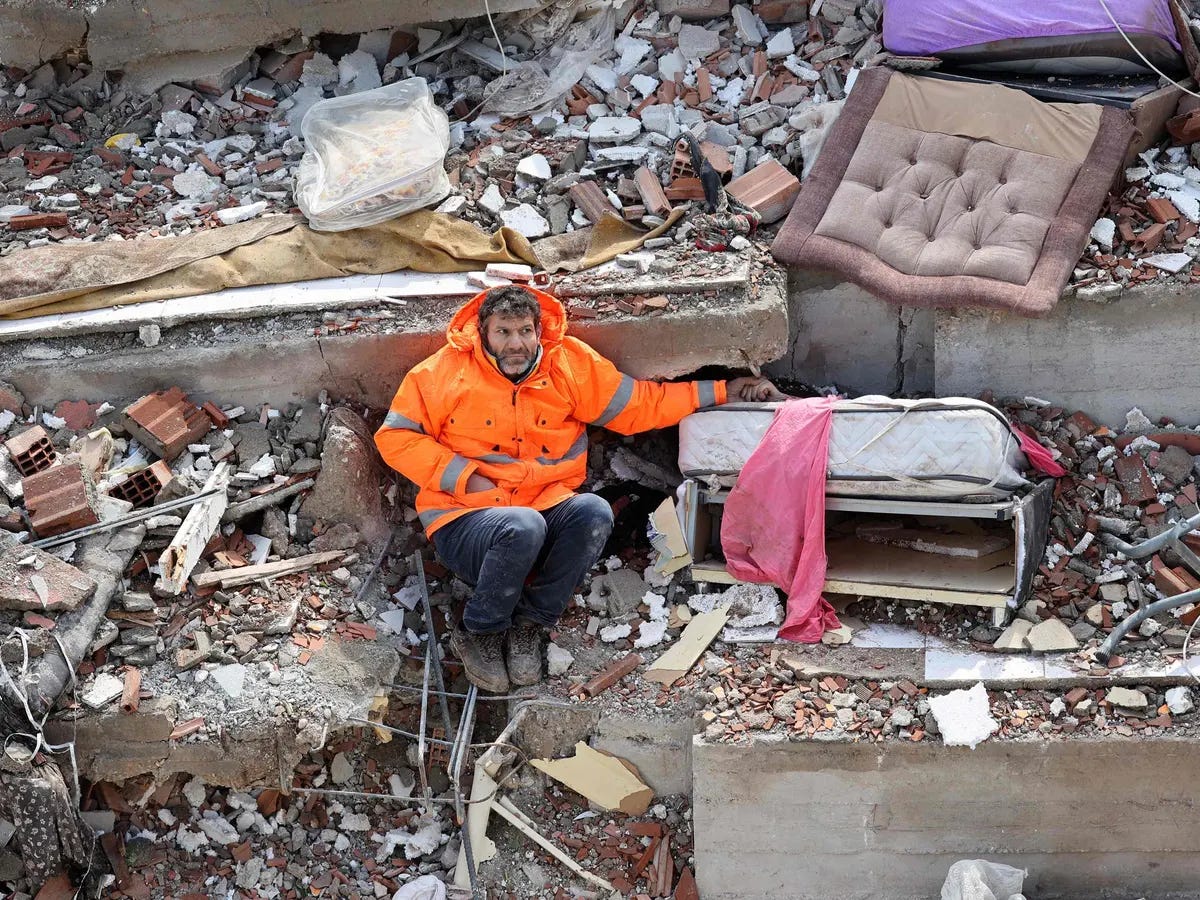
Image: The Guardian
Seismologist John McCloskey was shaken awake by an earthquake on 6 February this year. He was in Palestine, 650 km from the 7.8 magnitude earthquake in south-eastern Turkey: “The whole building was shaking. Wearing my seismologist’s hat, in the middle of the night, I said to myself, ‘That isn't a local earthquake, that must be a long way away but it must be really, really big’.”
Two decades before McClosky had pinpointed where a large earthquake was likely to strike in southeastern Turkey. The February quake struck in exactly that location.
The tricky thing about predicting earthquakes is that getting the location right is not enough. Prediction of the timing is essential to guiding short-term action and influencing long-term planning.
For a local example – there will be a serious earthquake on the Alpine Fault (the zone where the western regions of Tasman and the West Coast are sliding north relative to the south-moving Canterbury and Otago). There is an 82% chance of a greater than 8-magnitude quake in the next 50 years. Unfortunately we don’t know when in the next 50 years.
New Zealand is vulnerable to other disasters which are predictable, except for their timing. After cyclone Gabrielle produced catastrophic flooding of the Esk Valley (and many other parts of the North Island) we were reminded that the Esk Valley is flood-prone. The last major floods were in 1938. As Hastings District Councillor and historian Michael Fowler said, “Generations tend to lose sight of history.” That is, without a predictable date for recurrence of disaster people forget.
In Europe, recent droughts resulted in the exposure of ‘hunger stones’ in the beds of some rivers. In the Elbe River in the Czech Republic these words are carved in a stone: "Wenn du mich siehst, dann weine" ("If you see me, then weep"). This message to future generations ensured they would be warned of drought-induced famine.
Paleoclimatologist Richard Levy and his Victoria University of Wellington (Te Herenga Waka) colleague Tim Naish have modelled the combined effect of coastal subsidence (and elevation) and sea-level rise. As the land subsides local sea-level rise will accelerate. The upward land movement will delay the flooding effects of inexorably rising sea levels. Their graphic and detailed map shows what will happen around New Zealand’s coast (to a resolution of two km). But it is not certain if these changes will occur in 50 years, or five.
How do we manage the risks of earthquakes, floods and inundation by the sea? In a perfectly logical world, we would act now to minimise future risk. Seismic strengthening of buildings is an obvious example.
We continue to make progress on the seismic strengthening of New Zealand’s buildings. We still have a long way to go on issues such as relocating or electing not to build homes and other buildings in areas at risk of inundation.
At the bottom of my street in Auckland, many houses and an Early Childhood Centre were flooded in the January flood. Some still have yellow stickers. The Early Childhood Centre has been sold to a developer. The multiple units that the developer proposes to build on the site are on sale. I’m sure you know of similar issues where it's business as usual despite the high risk of future catastrophe.
A 2023 review of the climate action of 63 countries places New Zealand at 33rd – in the middle of the pack. Countries are evaluated on their 5-year trend in terms of greenhouse gas emissions, renewable energy, energy use and their climate policy framework and implementation. Is there a difference between those that are making better progress on managing the causes and impacts of climate change? At the bottom of the table are fossil fuel exporters Iran and Saudi Arabia – who have a vested interest in the continued sale of these fuels. The big emitters China and the United States are also near the bottom – indicating that change is slower with the inertia of well-established patterns of energy use.
Is it possible that having leaders who are more focused on the challenge of climate change helps to overcome vested interests and inertia?
I compared the leaders of the best 15 countries in terms of their rated action on climate with the leaders of the 15 worst-rated countries. There have been recent assessments of the personality of such leaders – for example asking local experts to rate their leaders on standard personality measures. Instead, I have collected the details of these leaders’ education and qualifications.
Are there any patterns in terms of the qualifications of the leaders of climate-action countries and those of climate-action laggards?
Trying to see the linkage between present leaders and ongoing trends in climate action is tricky. The leader in place now might not have been around when climate decisions were made last year. In Australia – in the bottom 15 for climate action – Anthony Albanese has recently replaced Scott Morrison. Morrison once brought a lump of coal to underscore the support his government would provide to the local coal industry.
Also, leaders might not set the agenda for climate action but simply represent the priorities of their electorate or of that country’s elite. A leader might be following the agenda of others.
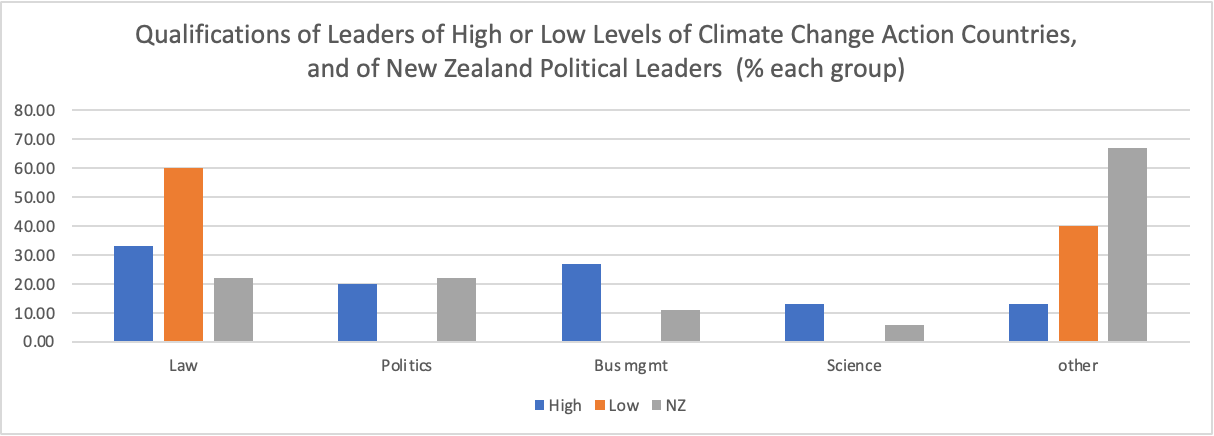
Leaders’ education and qualifications were retrieved from Wikipedia biographies. The four qualifications detailed in the chart (law, politics, business management, science) reflect where two or more of the 30 leaders had that qualification. Leaders with unique qualifications were counted as having ‘other’ qualifications. Leaders from New Zealand’s political parties were fitted into these ‘four plus other’ categories of qualifications (four leaders from each of National and Labour, three each from ACT and the Greens, two from Te Pati Māori, and the single leaders of New Zealand First and TOP).
Leaders of high climate action countries had somewhat different education from those heading slower-acting countries. There seem to be more paths to leadership in these higher climate action countries. Some leaders in higher climate action countries had qualified in politics, business management and science. In contrast, none of the slower-acting country’s leaders had followed these educational paths.
In both faster and slower climate action countries law is the most frequent path to political leadership. In slow-acting countries, the law is the dominant background of leaders.
While 60% of leaders in low climate action countries have a background in law, 60% of leaders in higher climate action countries have qualifications in politics, business management or science.
The qualifications of the 18 political leaders from New Zealand’s political parties are more similar to the profile of leaders of fast-acting countries. In New Zealand, the law is a route to political success, but not to a greater extent than other approaches. This diversity is also seen in the range of ‘other’ qualifications beyond the ‘big four’ seen in other countries.
We all know open-minded, change-oriented lawyers. Chilean President Gabriel Boric, a lawyer, was described by one of his professors as “having the capacity to doubt.” Generally, the law is about getting decisions right and lawyers are trained to minimise risk by ensuring they are following precedent.
To over-simplify – some qualifications encourage looking back and building on the decisions of the past to repeat success. Others encourage looking forward and exploring options for what could be possible, adapting approaches based on results.
The preponderance of leaders with legal qualifications in countries that are not taking timely action on climate fits with a backwards-looking approach by these societies to repeat what has worked before.
I am not suggesting that if you want more impetus to climate action you avoid voting for lawyers. To promote climate action you might consider leaders and parties with policies that are evidence- rather than precedent-based.

There is no satisfaction for McCloskey or anyone in seeing their prediction of disaster proved right. The only satisfaction is being able to reduce the terrible impact of such predictable disasters.
This article appeared (without the graph) in The Listener (19 May 2023)
Stewart Forsyth is a coach and writes on psychological and social issues.