Life's through-lines
What do our leisure interests indicate about us?

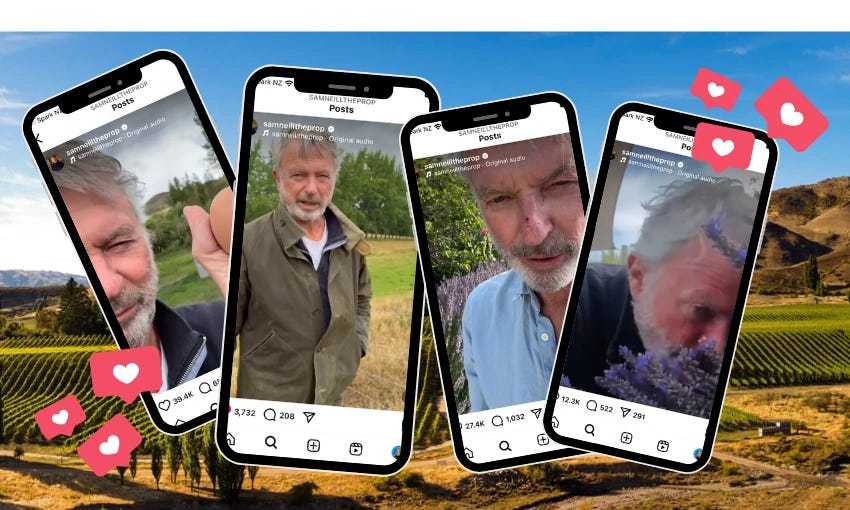
Image: thespinoff.co.nz
This is a sad week. We are coming to grips with the loss of Sam Neill – a modest and wonderfully relatable actor. Sam was an active guy. He told an interviewer that he was not afraid of death. Rather, that it would annoy him. It would take away his opportunity to do stuff. Sam was a winemaker as well as an actor, and also had a collection of animals including chickens, ducks and kunekune pigs. He made entertaining content celebrating his animals during the pandemic.
There are many wonderful stories about Sam shared by his many friends, for example Robyn Malcolm – “I thought he’d always be with us, like the Southern Alps”.
I am interested in the fit between his professional and his leisure activities. No disrespect to Sam, but he provides a neat opportunity to explore the idea that our leisure, or recreational activities, provide useful clues about the themes that provide through-lines to our lives.
Is there generally a match or mis-match between work and leisure interests?
High match - for example, I talked with a radiographer – someone who reviews scans to detect images indicative of disease or injury. One of their leisure interests was doing jigsaws. I think there is a link in terms of pattern-recognition here. Probably best represented by the interest “code” of Investigative.
Low match – best summarised by the bumper sticker seen in city traffic – “A Bad Day Fishing Beats a Good Day Working”.
Looking at Sam – His work as an actor rates strongly for creative and social interests (coding artistic and social in the traditional RIASEC model). Winemaking potentially represents more physical and technical themes (realistic and investigative). No obvious cross-over there. Maybe winemaking was a chance for Sam to do something completely different? He certainly saw that as a plus: “one is a kind of relief from the other.”
But, showing signs of my desperation, how about the content creation during the plague? That has a core of creativity, as well as the social dimension (artistic and social) – a great match to the themes underpinning his professional career.
People are complicated; we don’t expect that life themes, no matter how strong, are going to keep someone on a particular straight and narrow track. The radiographer also has a social life, and that doesn’t necessarily involve spotting intriguing patterns (although it might make him well-suited to social bowling).
And Sam did see making wine as more than a technical accomplishment: “wine is about conviviality. It’s so much more than what is in the glass. It’s about community.”
Patrick Armstrong and James Rounds found a strong match between work interests and leisure interests. Although there were some misses – being outdoors in nature (including adventure sports) and computer activities didn’t fit the 6-factor RIASEC model so well. This might be an indication of the need to expand the dimensions to include these domains rather than a sign that there is not a great connection between the themes underlying activities in the worlds of work and recreation.
Career coaches suggest you craft your CV so that your interests reflect your capability for hard work, relatability and good health. There is research indicating that people making hiring decisions are influenced by the suggestion that candidates do “meaningful” stuff (such as hiking or cooking) rather than relaxing or watching screens. The factor here seems to be that the decision-makers deduce that these wholesome candidates have higher competence.
It might be that more of us need to cultivate leisure interests, not to add gloss to our CV but because we may have serious involuntary leisure time as some jobs get automated.