Marriage prospects
Radicalizing unmarried males


Image: Wanaka wedding - shesaidyes.co.nz
On the early afternoon of 23 April 2018, a self-identified ‘incel’ driving a van ran down and killed 11 people on the streets of Toronto – 9 were women. Incels are an online movement of young males who believe they are shut out of the game of sex and attraction (‘incel’ being a contraction of ‘involuntarily celibate’). BBC journalist Jonathan Griffin describes incel online forums in terms of themes of failure, frustration, along with anger and hate. Their rage is directed at caricatures of women.
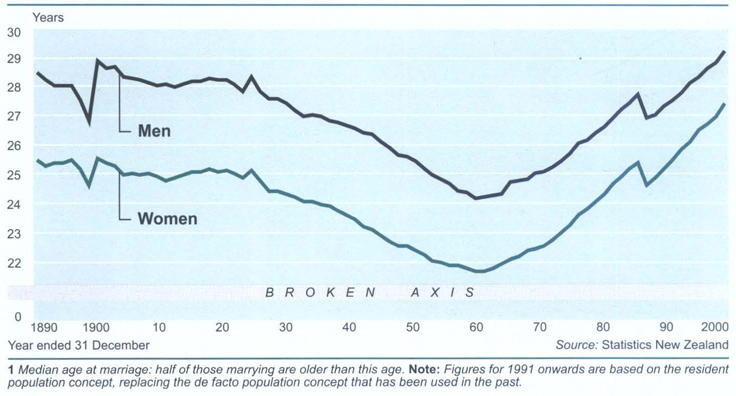
Young people are taking longer to get married. This is not just a local thing – since the 1970s the age of marriage has risen in 75 of 77 countries surveyed by the UN. The 1960s and 70s was an era of relatively young marriage age – the base of a ‘U-shaped’ curve (shown below for New Zealand). Successive generations have waited longer and longer to marry. In the 60s the average New Zealand male married at 24 to a woman of 22. Their grandchildren will be, extrapolating present trends, 34 for men and 32 for women when they marry in the 2020s.
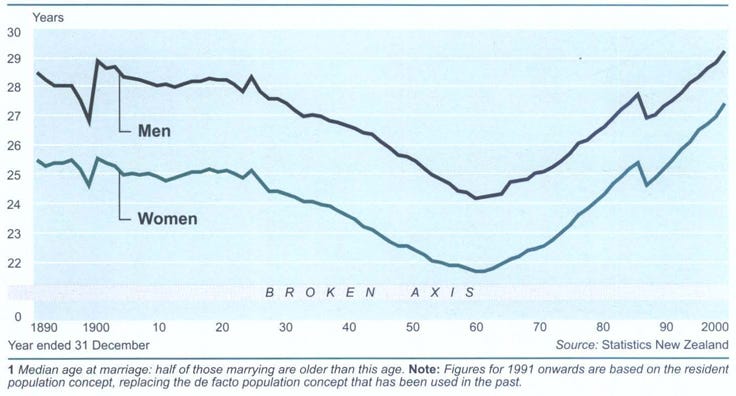
Chart: stats.govt.nz
According to parental investment theory, a term coined by Robert Trivers in 1972, the sex that invests more in its offspring will be more selective when choosing a mate, and the less-investing sex will have to compete more to win a partner.
Universally both men and women are looking for the same things in a future partner – intelligence and kindness. But then there is a gender split, as predicted by parental investment theory. Men are looking for attractive partners. Women are looking for reliable providers (earning potential and ambition are the signs). If women don’t see good prospective partners in their local dating pool they will hold off on marriage.
Using fine-grained economic data from the era of the Great Depression (1920-1939) US economist Matthew Hill found that marriage rates for men went down with shrinking local economies and local unemployment. As opportunities improved in the female labour market – women were less likely to marry. It’s as if women’s improved financial situation led them to be even choosier about partnering during these tough economic times.
Right now, an aspect of rising inequality is that fewer people with more wealth also have better marriage prospects. Pew researchers report that marriage has declined far less for US adults with university qualifications.
As noted at the top there are more serious implications of this trend to delay marriage than old people wondering if they’ll ever see grandchildren.
Unmarried young men are a serious risk factor for crime. A comprehensive paper by Joseph Henrich and colleagues demonstrates that societies can expect to see more murder, rape, assault and other crime as result of more of these males. China and India, with their selective abortion of females, and increasing numbers of unmarried males, show these results. In China male to female sex ratios rose from 1.053 to 1.094 over 1988-2004, doubling the number of unmarried or ‘surplus’ men.
This policy was implemented at different times across different provinces. This provides a macabre naturalistic experiment – analyses show “a 0.01 increase in sex ratio is associated with a 3% increase in property and violent crimes.”
The same dynamic is likely to be playing out locally, including violent protests. Even if only a part of the story, we see the impact of unmarried men feeling they are shut out of economic and social opportunities and radicalized by hateful online narratives.
Stewart Forsyth is an organisational psychologist and executive coach and also the author of 21 Remarkable People – available from Amazon or Apple or other eBook sources.