

Using stars as guides: Moana shows the power of Polynesian celestial navigation. Image: Walt Disney Animation Studios
Veronica (not her real name) trained as a nurse in the 1970s. She was registered and worked in acute nursing roles in New Zealand and the Pacific Islands. Her work included training and supervising nurses and nursing aids. She has had career breaks for child-care and to nurse her father. She has not been in work for the last 5 years, and now aged 65 she is considering returning to work.
She needs to earn over $40 per hour, preferably working a 3-day (or 24-hour) week, and in a job that has minimal chance of being displaced by technology in the next 10 years. She scores highly on the “Health Science” and “People” dimensions of the SETPOINT vocational interest scale (more about SETPOINT below).
Veronica illustrates the value of vocational or work interests. Many people don’t notice their career interests. They have skills and they attempt to find the jobs where those skills will be valued. In their work lives, some jobs worked out, others were less satisfying. They are as likely to attribute their different reactions to these jobs to the people they worked with (“super-lovely people” say), or their boss (“a total dick-head” maybe), rather than what their interests brought to the opportunity.
What makes a job cool is often how it fits with job interests. As researcher Paul J. Silvia puts in, job interests are “associated with persistent engagement in activities, even when complex or perplexing.” By assessing work interests, it is possible to shine a light on these hidden career guides.
In this view a good job is the result of the connection of both work interests and work skills with the demands of the job.
In a delightful article last year Adam Mastroianni made the point that people can like the idea of a job but not be too sure about what the job involves. He suggests unpacking the job into tasks to check how you relate to this job reality. He describes students who thought that being a professor would be cool. He suggests that they talk with Dan Gilbert, a mate of Mastroianni and a real professor. Gilbert demonstrates how much of his job involves looking at a screen and writing (grant proposals, journal articles, book chapters, and so his day goes).
Another way of unpacking jobs is completing a work interest assessment, rating how enthusiastic you are about doing different tasks (including working on car engines as well as writing journal articles).
The SETPOINT inventory is a recent development in this area. It has advantages over job interest measures developed in the 1980s (or earlier). It includes jobs in tech and health sciences that didn’t exist in the 80s. It provides trait-like measures – so you can assess your relative interest in different work dimensions. And it has arrived as new research indicates that job interests add to the “predictive power” of tests of intelligence or personality, the established “predictors” of career success.
Here’s what the 8 dimensions of SETPOINT look like, summarised in terms of the dimension, a description and a sample item:
S – Health Science
Interest in healthcare roles, wellness, and medical practices.
“I enjoy learning about human anatomy and health interventions.”
E – Creative Expression
Enjoyment of arts, writing, design, and other creative pursuits.
“I like working on creative projects like designing graphics or writing stories.”
T – Technology
Fascination with engineering, coding, technical systems, and innovation.
“I am drawn to solving technical problems using gadgets or software.”
P – People
Preference for interpersonal engagement, counseling, or teaching.
“I enjoy helping others solve their personal or interpersonal issues.”
O – Organization
Interest in structure, systems, administration, and data management.
“I like organizing information and keeping processes running smoothly.”
I – Influence
Attraction to leading, persuading, and influencing others or groups.
“I feel energized when presenting ideas to influence others’ decisions.”
N – Nature
Engagement with the outdoors, environment, animals, and ecological work.
“I feel fulfilled working outdoors with plants, animals, or natural ecosystems.”
T – Things
Preference for working with objects, tools, machines, and hands-on tasks.
“I enjoy repairing or building mechanical objects or devices.”
By including job interests we can expand our search for career options beyond “skills for hire”.
An example of Veronica’s job options:
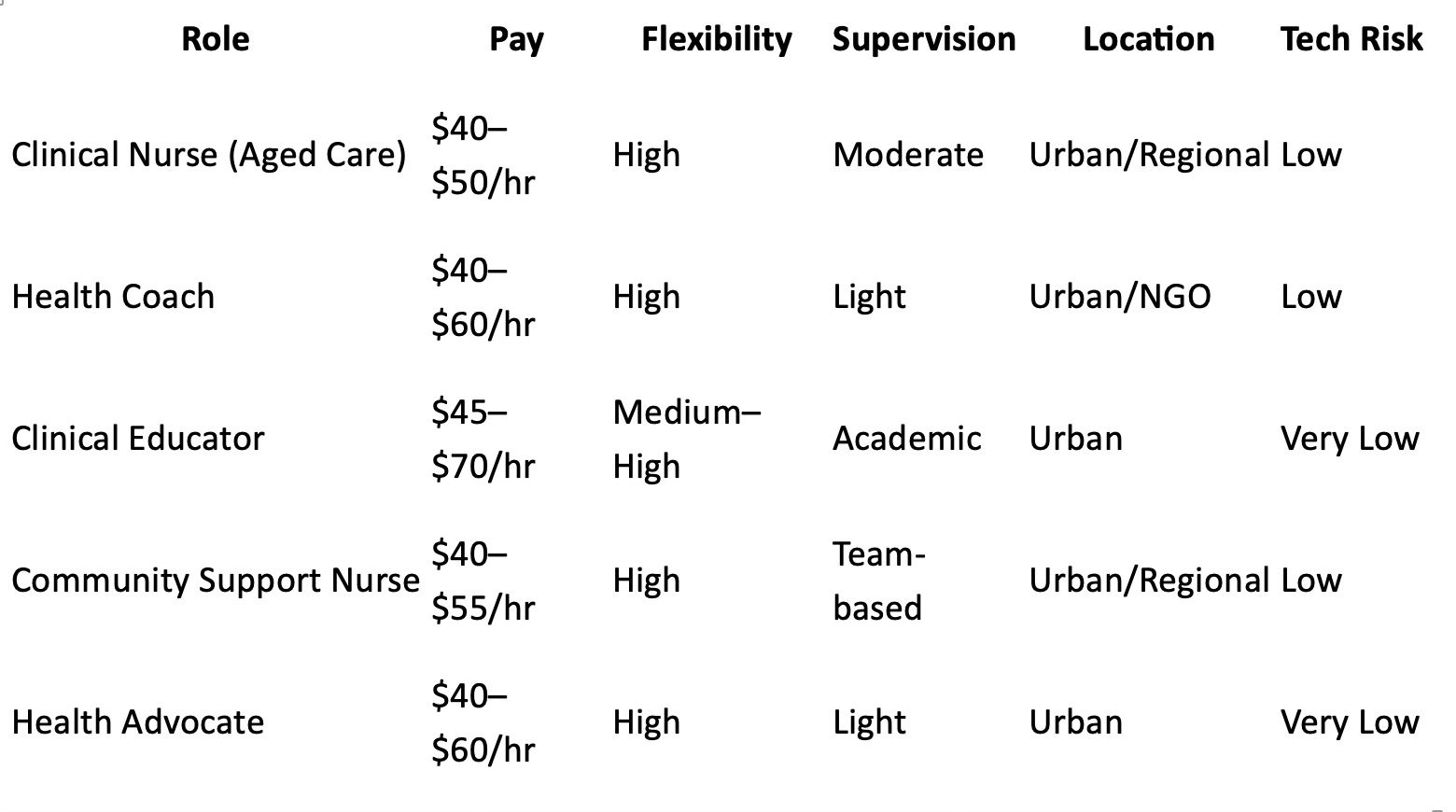
Job choices are bounded by constraints such as commute time, livable earnings, and work flexibility. Then, there are more strategic, career issues. Will the robots come for this sort of work in the next 10 years? Is this a dead-end career? These are all important aspects of your search for your next job. But don’t ignore your career guides – what do your job interests indicate could be satisfying, fulfilling and ultimately motivating career choices?