Organising pirates
Outlaw groups need rules to succeed

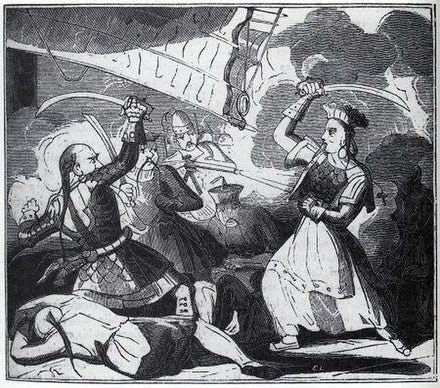
Image: Cheng I Sao, pirate leader, from Wikipedia.org
In 1801, in the South China Sea, pirate Zheng Yi’s flagship came alongside the floating pleasure ship run by Madam Cheng I Sao. From this beginning, Zheng Yi and Madam Cheng became a serious power couple. Zheng Yi ran a confederacy of pirate fleets. Together with Cheng I Sao (also known as ‘Zheng Yi Sao’ – the wife of Zheng Yi), they formalised their pirate confederation. Cheng I Sao seems to have provided the organisational capability to support their piratical enterprise.
Earlier, on the Caribbean, Atlantic and Indian Oceans, the ‘golden age’ of piracy (from the early 1700s to around 1730) reflected the attraction of outlaws to the valuable cargoes being shipped to Europe. This was the era of Stede Bonnet and Captain Blackbeard, real pirates who inspired the drama Our Flag Means Death (featuring respectively Rhys Darby and Taika Waititi, and streaming on Neon).
If you are a pirate, and you come across a treasure as you ransack a prize, is it yours or part of the commonwealth to be shared equitably? When pirates have an issue around dividing their booty they can’t call in law enforcement to their ‘nest of rogues’, or lawyer up for a court battle.
Stede Bonnet, the ‘gentleman pirate’ was unique in paying his crew wages. Typically remuneration was a share of the booty – no prey, no pay. As historian Patrick Pringle described it, a pirate ship was like a “sea-going stock company” – with all who sailed on it stock-holders. Their business was violent plunder and the ship needed internal order to achieve this goal efficiently.
Peter Leeson has written of the organisational model that evolved to ensure piratical success.
To minimise internal conflict and ensure ongoing cooperation for mutual gain these pirates applied a rules-based approach – rules for sharing earnings, for maintaining standards of behaviour (all disputes settled off-ship, no raucous partying below decks after 9:00 pm). Pirates signed an agreement before they went off to plunder. Their organisation extended to the election of leaders – including the captain.
Punishments for rule-breakers included slitting of nostrils and ears, death, or being marooned – often a death sentence.
These rules were consistent from ship to ship in the Indian and Atlantic oceans throughout this era. Leeson asserts that this consistency is evidence of an effective solution to the pirates’ organisational problem.
Across ships, there was a consistent division of leadership. William Snelgrave was captured by pirates, but survived to describe his experience in 1734: “the Captain of a Pirate Ship is chiefly chosen to fight the Vessels they may meet with. Besides him, they chuse another principle Officer, whom they call the Quarter-master who has the general inspection of all Affairs and often controuls the Captain’s Orders.”
Pirates of the West such as Captain Morgan and Captain Bartholomew Roberts led fleets of pirate ships. Morgan at one stage led 37 ships and 2,000 men. Roberts “had a force of at least twenty vessels in quest of plunder.”
These were fearsome fleets. But according to historian Joseph MacKay, Cheng I Sao and her husband led a confederation which at its peak included seven fleets of up to 400 junks and 60,000 men. That would have taken some organising. In 1805 the heads of the fleets signed an agreement that restricted raiding practices, imposed fines and punishments for disobedience and prohibited attacks on vessels that had paid protection (Cheng I Sao sold ‘safe passage’ documents to all in her sphere of power).
In this confederation, disobedience, stealing from the common treasury or from villagers who were suppliers to the fleet was punished by immediate decapitation. Spoils of raids were registered with the pirate’s purser.
In the East, as in the West, a social organisation evolved to ensure that the murderous business of piracy proceeded efficiently. Rules and consequences for rule-breaking were fundamental to these societies of outlaws, who by the nature of their trade were beyond the reach of the state and its law.
Similarly, leaders came in two broad types. In the West and the East, the Captain led attacks – making decisions that determined the success of their engagements. The Captain was supported by a Purser or Quartermaster who enforced the rules and ensured the harmony of the ship, and its effectiveness as a weapon of piracy.
In 1810 Cheng I Sao negotiated a surrender to the local authorities. She and her new husband (Zheng Yi had fallen overboard in a storm) avoided prosecution and retained most of her then fleet of 24 ships and 1,400 pirates. She lived a peaceful and prosperous post-piracy life.
Stewart Forsyth is an organisational psychologist and executive coach and also the author of 21 Remarkable People – available from Amazon or Apple or other eBook sources.