Owls vs. larks
Tune into and work with your chronotype

Did you wake early this morning, then fit in the gym and some meditation before breakfast? Or after a somewhat late night on the coach with your screen and a cheeky glass or two of wine did you hit snooze when the alarm disturbed your slumber?
Not many people fit these stereotypes. Not many people can be described as hard-out larks or owls. Like most things about people – there is a dimension from larkiness to owly – with most people in the middle. Lots of us do get up early on occasion, and also pull some late nights.
But this is a real dimension of human nature, and there are some interesting differences between people at the extremes. It is not a coincidence that people more inclined to the ‘dark side’ are also more likely to be prowling after hours. Nor that bright and early folks do well in terms of the conventional measures of success.
How do we know that these things are not just random happenings? The folks who developed the Morningness-Eveningness Questionnaire (MEQ) measured the body temperature of those who completed the survey. Larks would be expected to have a higher core body temperature early in the day, and the same for owls in the evening. And the results validated this. A sample question on the MEQ – a friend suggests you meet for a workout at 10pm – how well do you think you’d go?
What distinguishes larks or owls beyond the diurnal cycle of their body temperature? Research based on ‘actigraphic’ (motion-sensors) trackers (think Fitbit) indicates that those that regularly get to sleep early are more conscientiousness – the plan it, knock it out sort of individuals. What about those who hit bed later and are also more variable in how much actual sleep they clock up? Extroversion is the trait in play here. Think of those who are excited about watching the next episode or for who the second (or third) glass full has got to be better than the first.
Another way of tracking people is to capture what they are doing online. Looking at large samples of students logging into and out of online academic systems researchers were able to compare larks and owls (early or late to log-on) in terms of their academic performance. These researchers interpreted these results in terms of Social Jetlag. Students who typically rise early (and hit the online books early) and then presumably go to bed early are not going to manage the social demands of late nights over the weekend. Those who are used to a later routine are going to find weekends fine – but then there is the week, with early starts taking a toll. The owls are accumulating a larger Social Jetlag – and this is reflected in their poorer academic results.
In a paper provocatively title Creatures of the Night
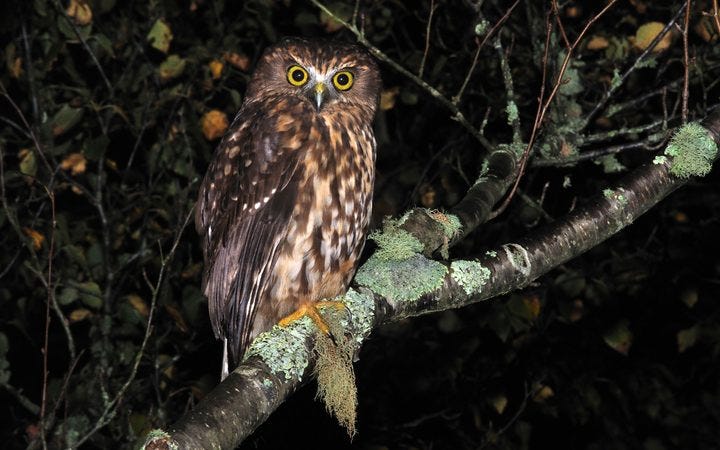
Image: https://www.rnz.co.nz/
Peter K. Jonason and colleagues demonstrated that those with psychopathic inclinations are more likely to be owls.
The authors have a compelling evolutionary story around these tendencies. If psychopaths are those who prey on their fellows, then operating in the shadows has advantages. They are going to be mentally sharper after dark than their socially jetlagged non-owl targets. There is evidence that owls are better cognitively during the day too – so they are often more than a match for larks who get duller as the evening wears on.
What are the implications for you and those you get along with? The obvious one is to work with your ‘chronotype’. If you are larkish – are you picking up mentally demanding tasks early in your day rather than muddling through your email? If you are owl-like – can you build some crash-barriers into your week-time schedule so that you are getting to bed and ready to sleep (without caffeine or alcohol in preceding hours for example) so that you are able to bounce into the new day?
Thinking of those you relate to – are you flexible enough to adapt to meet them at least some of the way? Is that early morning meeting the only option for the team?
Thinking of that ‘dark side’ – what can you do to ensure you are safe, or at least you are minimising your risk when you are out and about at a time when you are not as alert as you might be in sunlight.
Sleep well!
Stewart Forsyth is an organisational psychologist and executive coach and also the author of 21 Remarkable People – available from Amazon or Apple or other eBook sources.