Productivity or ideology?
How to make a difference


The hospital proposed for Dunedin in 2023 - the proposal has since been scaled back: image: southernhealth.nz
According to David Seymour, leader of the ACT party, the regulatory environment created by the Regulatory Standards Act will improve productivity: “New Zealand’s low wages can be blamed on low productivity, and low productivity can be blamed on poor regulation…It’s not just that red tape has disempowered people and businesses, it is replacing the No. 8 wire, can-do Kiwi attitude with a culture of fear and paperwork.” (quoted in a November 2024 Newsroom report.)
NZ has a productivity issue. Productivity is fundamental to us affording the quality of life we value. That means good education, health care and benefits – including the 52% of the benefits budget going to superannuitants.
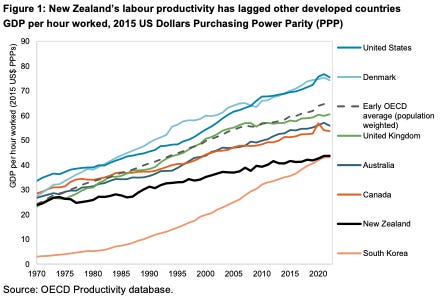
As the chart shows (from a Treasury report last year) New Zealand continues a history of poor productivity compared to other developed countries. With an increasing proportion of dependent people ahead this will be an increasing problem.
Much has been written about getting us out of this fix. A useful approach is to review what other “small advanced countries” have done to maintain higher productivity. There is consensus that the mix for success includes innovation and competition, especially global competition – being able to compete with the best.
In From Wool to Weta physicist and entrepreneur Paul Callaghan wrote in 2009 that New Zealand needed 100 F&P Healthcare-sized businesses to ensure good living standards. In 2020 David Skilling, policy advisor and former Chief Executive of the New Zealand Policy Institute, writing for Treasury, emphasised that lifting productivity rests on developing “frontier firms” (firms that achieve above-average productivity). That is firms that that scale into competitive international markets. Such firms need to be large and to be embedded in deep clusters.
Another review of frontier firms in New Zealand and internationally found that New Zealand firms underperform in picking up technology and in allocating labour efficiently (we have more labour in less productive firms). This doesn’t help New Zealand businesses average 53% productivity relative to the average of the five comparison small advanced countries.
This is not the only research into lifting productivity in our productive sector, but I am struck by the limited emphasis by these smart people on the stifling effect of regulation. Looking again at the history of New Zealand’s productivity (illustrated in the chart), we can see there was a boost to productivity during the burst of deregulation in the late 80s. An improvement, but not for long.
There is solid evidence that business-level productivity can be enhanced through better management of people. Researchers from Murdoch University in Perth pooled 232 samples across 20 countries and 56,868 businesses to check the relationship between people management practices and operational and financial performance. They were especially looking at how a strategically coordinated package of practices (for example, aligning recruitment, training and remuneration) is more effective than arbitrary approaches to these practices. How could this work? The business could be identifying mission-critical skills, and then targeting recruitment and training to lift the level of these skills across the firm, while also arranging for pay to reflect individual’s skill level.
The Murdoch researchers found that strategic bundling of people practices did lift business performance. The average improvement in business performance was 7%, not a huge number but one that would be welcomed by investors. This result held across 19 of 20 countries. New Zealand achieved an estimated improvement in business performance of 14% – higher than average, but based on only four studies.
To end on a positive note – I have two suggestions for where Mr Seymour would get better results for his efforts:
1. Investment – dollar for dollar matching by the government in designated frontier firms’ investment in other local businesses – including for R&D, training, coaching and other professional services. This would enhance the development of clusters and the diffusion of knowledge and skills within these.
2. Prizes for most improved productivity (earnings per FTE) across sectors for small, medium and large businesses – with annual score-cards to tabulate relative productivity. What gets measured, and communicated, gets attention, maybe even gets valued.