
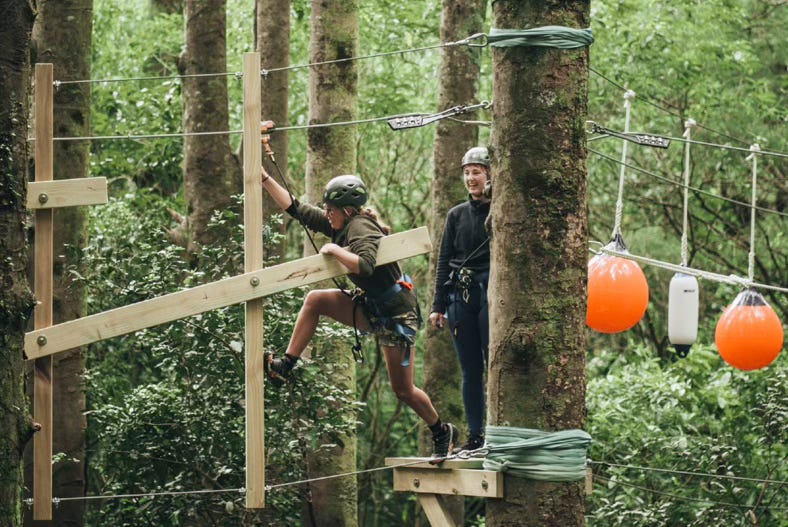
Taking a leap at Outward Bound - “the Anakiwa challenge”: https://www.outwardbound.co.nz
New Zealand has a relatively high number of entrepreneurs (business founders), with high-flyers (sorry) such as the ebullient Sir Peter Beck rightly attracting attention for their achievements (my profile of Sir Peter’s personality is here).
Before I explore the paradoxical result that this large number of New Zealand entrepreneurs does not generate adequate growth for the country, I want to pick up on the impact of early trauma on entrepreneurs’ success. You might know all about this, but I found it astounding.
In a great study, Wei Yu and colleagues studied the (recalled) childhoods of 573 US entrepreneurs. They hypothesised that some level of adversity would build resilience, which in turn would enable the would-be entrepreneurs to survive the rigours of starting a business. They developed an index of such early trauma (building on the finding that it’s the intensity and duration of trauma, rather than it’s nature, that matters).
They found that a moderate level of such trauma predicted business success. This makes intuitive sense – too little stress, and it is difficult to learn how to respond resiliently to pressure. Too much can mean the individual is overwhelmed.
Lynn Barensden did a smaller study of US social entrepreneurs (she defines them as solvers of social problems through the application of entrepreneurial spirit and business acumen). Many of the sample of 17 social entrepreneurs had experienced early trauma, but none of the 15 business entrepreneurs she used for comparison.
This does not mean we need to go all outward bound on young people (that’s New Zealand’s demanding outdoor experience involving isolation, cold swims and survival skills in the wild for those outside Aotearoa – New Zealand). It does suggest that demanding but safe experiences should be part of young people’s development.
It also gives a boost to coaching approaches such as the imagery rescripting included in schema coaching. In this, traumatic experiences are re-lived with a positive, effective, script. This approach moves the coachee beyond surrendering to the trauma to seeing their new response to it as an indication of effectiveness. In the future, similar situations are framed as a challenge.
Returning to the gap between the number of entrepreneurs we have in New Zealand and the impact on economic development. In a 2011 study Howard Frederick and Erik Monsen contrasted us with other countries – and identified New Zealand as an outlier. Less developed countries had a lot of entrepreneurs – because in these countries, that is the only way to go if you have ambition (my interpretation, not theirs). Highly developed countries have a lot of entrepreneurs – people creating value that existing businesses are too stuck to exploit (again my take). New Zealand has a lot of entrepreneurs – but only middling growth. Frederick and Monsen have some radical suggestions – including lower company taxes, more government intervention in promoting economic (versus “lifestyle”) ventures, and more emphasis on manufacturing and service productivity.
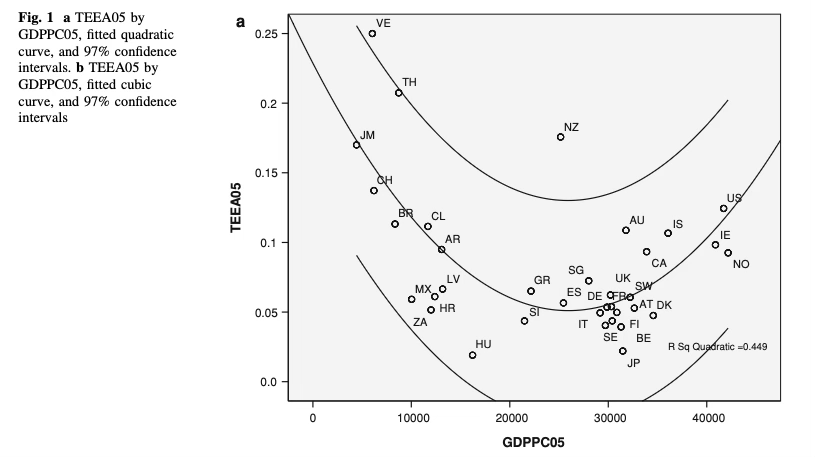
Figure 1 from Frederick & Monsen (2011): - the “x”, bottom, axis shows each country’s economic growth (GDP), the “y”, vertical, axis each country’s proportion of entrepreneurs: New Zealand sits in the middle - too many entrepreneurs for its weak level of growth.
They summarise this by suggesting we need a more “Schumpterian” business environment (that’s named for Joseph Schumpeter, the Austrian economist who saw capitalism as “creative destruction”). Just the environment for resilient entrepreneurs.