Russian lies:
Who believes them?

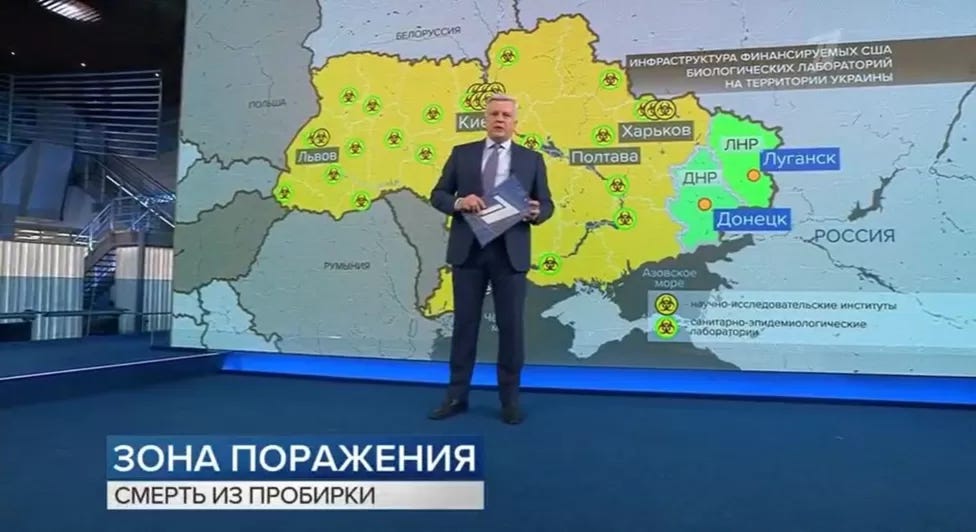
Image: BBC.com - Russian state TV has been showing sites which officials say are being used to develop bioweapons
Russia is fighting a war in Ukraine, and also an information war internationally. Russia, or more particularly, its intelligence services, invented ‘dezinformatsiia’ – lies and distortions aimed at confusing its adversaries. An early effort by Russia's KGB was the story that the US had created HIV/AIDS as part of its biological weapons programme.
Russian disinformation is designed to control its people and further its foreign policy. Russian authorities keep up messaging that Russia is under threat from NATO and other forces of the West. Meanwhile, a succession of wars and annexations during Putin’s regime (Chechnya - 1999, Georgia - 2008, Crimea - 2014, Syria - 2015, and now Ukraine) are characterised as responding to the provocations and incursions of the West, or the proxies of the West. Russians are reminded that external peril is ever-present.
The pseudo-threats created by Russia are very scary. Any conspiracy won’t do – it is important to connect with already embedded ideas. So the United States owns a network of secret biolabs in Ukraine where dangerous viruses are engineered. A story from a Bulgarian news site claimed that the US government “conducted biological experiments with a potentially lethal outcome on 4,400 soldiers in Ukraine and 1,000 soldiers in Georgia”.
If I spread this conspiracy I am possibly spreading ‘misinformation’ – the information is false, but I don’t have malicious intent. When QAnon mouthpieces spread the story about America’s bioweapons being manufactured in Ukraine (as they did), they could be acting maliciously or just being gullible.
It is not enough to manufacture such lies, people watching TV or other screens need to be receptive. If you or I were told about Ukrainian facilities producing bioweapons we might go looking for independent evidence. Why do some Russians (and others) uncritically connect to such amazing stories? And then spread them?
Remarkable research by Dmitry Grigoryev and colleagues of Russia’s National Research University clarifies the nature of the mindset that is open to such dubious claims. For Grigoryev, this blind acceptance is an aspect of authoritarian thinking.

Those with an authoritarian mindset are inclined to see the world as threatening – both dangerous and competitive. They are more patriotic, and nationalistic. They are vulnerable to conspiratorial thinking, suspicious that what they read or see via the mainstream media is part of a propaganda machine. This cynicism limits their trust of scientists and public health initiatives. Those in Russia subscribe to a national siege mentality, and amongst other things, watch TV.
For Grigoryev this authoritarianism is the psychology of group tribalism – an inclination to rally around a strong leader – exploited by Vladimir Putin and fellow strongmen in other nations.
There is a cost to believing disinformation. Russia has spread lies about the effectiveness of Covid-19 vaccines – particularly the m-RNA vaccines developed by Moderna and Pfizer. The goal, as with disinformation about AIDS, is to reduce trust in Western health initiatives.
This disinformation appears to have rebounded against Russians. In Russia vaccine hesitancy is remarkably high. And vaccine hesitancy is dangerous.
A county-level analysis in the US by Dan Albrecht of Utah State University found a clear association between support for Trump, vaccine hesitancy and in turn Covid-19 death rates. Measuring across the 3,112 counties in the US Albrecht found that counties where Trump polled below 25%, had death rates of less than half of counties where Trump received more than 75% of the vote (death rates over March-September 2021).
Since 2019 and the pandemic Russian life expectancy has reduced – from 73 to 70 years. There is a wide gender gap – men’s life expectancy dropped to 65.5 in 2021. This adds poignancy to the protests around the Russian government’s recent efforts to increase men’s retirement age to 65. Many men would have little time to enjoy their retirement if eligibility was pushed to 65.

It is worrying to see individuals in the West buying into these disinformation initiatives. Are they aiming to act against their people or simply enthusiastic spreaders? These retailers of Russian disinformation often have their agenda. American Joseph Mercola (a renowned ‘super-spreader’ of vaccine conspiracy misinformation who also tweets messages opposing humanitarian aid to Ukraine) makes money selling health supplements and has a vested interest in knocking vaccines.
In New Zealand spreaders of vaccine falsehoods such as Chantelle Baker of Voices for Freedom and Kelvyn Alp have also voiced support for Russia’s invasion of Ukraine. They have to keep putting out incredible conspiratorial stories to keep their subscriber numbers and likes up – and the Russians keep providing attention-grabbing material.
Assuming that it will come to an end for Putin – as the Russian military realise the risk of them joining Putin in a sticky defeat – the challenges of rebuilding Russia will include reducing both the production and the impact of disinformation. That will require promoting evidence-based thinking around the world, including skills in critical thinking, and building trust in the integrity of health professionals, independent journalists and others who irk the world’s strongmen.
Stewart Forsyth is an organisational psychologist and executive coach and also the author of 21 Remarkable People – available from Amazon or Apple or other eBook sources.