
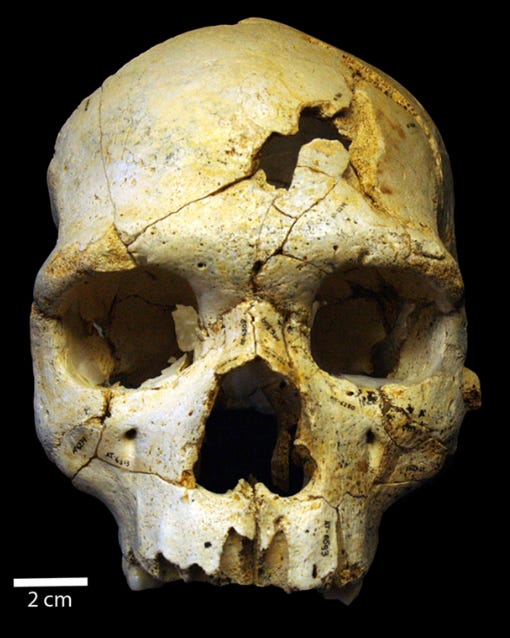
Image: Sala N, Arsuaga JL, Pantoja-Pérez A, Pablos A, Martínez I, Quam RM, et al. (2015) Lethal Interpersonal Violence in the Middle Pleistocene. PLoS ONE 10(5): e0126589. https://doi.org/10.1371/journal.pone.0126589
This is the first in a series on the mystery of why humans are violent towards other humans. This is a popular topic – why do we consume so much murder-themed content? My theory is that we’re wired to ensure our, and our relative’s safety. Over time a big threat to that safety has come from others, so we are super sensitive to information about the possibility of murder.
The series will clarify the two different types of lethal violence, and the facts and fiction about what drives murder. Is it a homicidal culture of honour? The increased power of elites? the arrival of migrants? The drug trade? I hope you find the evidence fascinating, and ultimately useful in forming your opinions about how we can shape a more tolerant and peaceful society.
The chimps are on patrol – a group of males, silent, super-vigilant, venturing into the territory of a neighbouring group. If they surprise a lone chimp from the other group – it’s murder.
Kevin Langergraber of Arizona State University examined twenty years of data on who participated in patrols in a 200-member-strong Ngogo community of chimpanzees within Kibale National Park, Uganda.
Patrolling comes with risks – violent attacks can lead to defensive retaliation – and injury. There are benefits – the Ngogo expanded their territory by 22% in the decade to 2009, while killing 13 individuals from groups outside. Individual Ngogo males live longer, and those that patrol (not all of them do) have more offspring.
Meanwhile, over in the Lola ya Bonobo sanctuary in the Democratic Republic of Congo bonobos, another primate species, demonstrate empathy for others, even if they are strangers. A clever experiment paired bonobos, separated by a high fence. These match-ups included bonobos that didn’t know each other. One of the pair could trigger a piece of apple to fall – into the enclosure of the other bonobo. A large proportion of bonobos did the generous thing and dropped the treat for the other bonobo – even if they’d never seen that individual before.
Chimps, bonobos and humans share a common ancestor and 98.7% of their DNA. Are humans more chimp or more bonobo when it comes to their inclination to generosity or violence?
Are we as Thomas Hobbes saw us? Or Jean-Jacques Rousseau? As far as we know neither knew about chimps or bonobos. Both had views of human evolutionary origins. Even though evolution wasn’t a thing in their time. They did understand that living in cities and nation-states was a recent development. They disagreed about what people were like before such inventions.
Thomas Hobbes (1588-1679) considered that man (Hobbes was living in an era a little before more inclusive terms) was out for himself – fighting against all. To ensure that life was not “solitary, poor, nasty, brutish and short”, men had to work out a contract with a powerful protector – we give up our rights, you, Leviathan have absolute sovereignty, and in return will look out for us.
Jean-Jacques Rousseau (1712-1778) considered humans capable of acting with compassion to others (including other animals). For Rousseau people develop a conscience and with it a love of justice and morality. Rather than a powerful sovereign emerging from anarchy Rousseau considered legitimate states could emerge and act for the “general will” of their members.
Rousseau was not terrifically optimistic about the evolution of legitimate states. It was inevitable in his view that there would be a conflict between society's factions. A possible outcome would be the emergence of elites that oppress those under them.
A rich study published in Nature in 2016 by José María Gómez (and colleagues), of the University of Granada in Spain, provides evidence about our ‘natural state’ and how we have since evolved. These researchers compared the evidence of animal violence (against others of the same species) across 1,024 mammalian species of 137 families, including the primates) to develop an estimate of human violence based on our relatedness to these animals (a more detailed view of the chimps vs. bonobos comparison).
Gómez also looked at trends in human violence – from the deep past of our species, where violence is deduced from bones disinterred by archaeologists which show evidence of spearing and hacking (an example is the image of the skull showing evidence of death by blunt force trauma at the top of this article).
Given our phylogenetic heritage – how do we compare with other more or less closely related species? The simple answer is that we could expect that around 2% of human deaths would be perpetrated by other humans.
That is approximately the level we find in the archaeological record. But humans have evolved from when our ancestors were living in small nomadic bands of hunter-gatherers. These days death from homicide is around 1% (on average – more about how that average obscures massive variability soon). That’s a big drop – violent death has halved from hunter-gatherer days to the present. But it’s not a straight line down from our pre-history to the present.
About the time we settled down from our nomadic hunter-gatherer lifestyle – building shelters in increasingly dense settlements near our domesticated crops and animals – things got more violent. In these societies around 9% of deaths are the result of human violence. More than four times higher than the days of hunting and gathering.
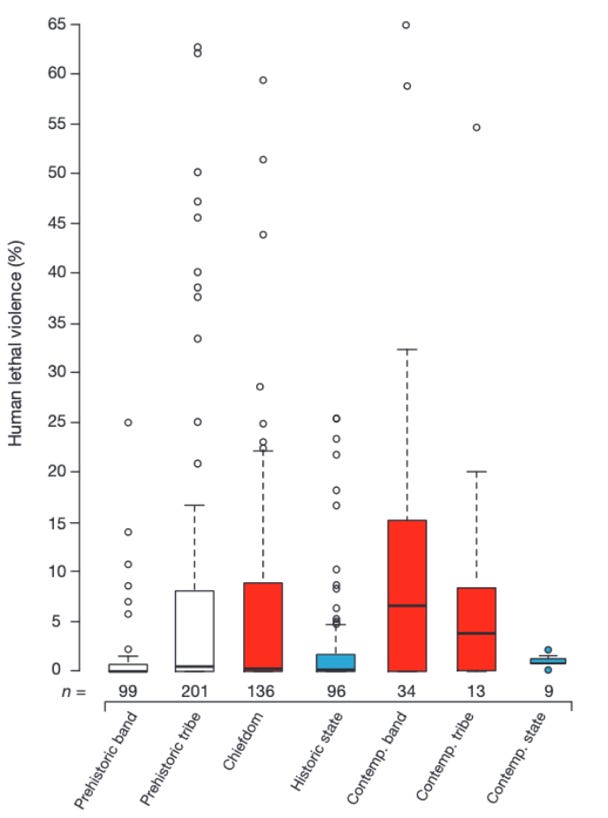
Figure 3d from Gomez et al (2016). The two white bars on the left illustrate lethal violence in different social groups – hunter-gathers (‘Prehistoric band’) and ‘Prehistoric tribes’ – the white indicates these samples are not different from the ‘2%’ level expected from the phylogenetic research. The numbers under the bars are the numbers of studies for each of the estimates. The next, red bar (‘Chiefdom’) represents settled, hierarchical societies – red indicates significantly higher levels of lethal violence; above the 2% level. The two blue bars – including the tiny one on the right are for ‘Historic’ and ‘Contemporary’ states respectively – the blue indicates they have significantly lower levels of lethal violence. Trust me – ignore the two high red bars on the right (‘Contemporary band’ and ‘Contemporary tribe’) – Gomez considers their high levels of lethal violence to be the product of recent colonisation and oppression.
What was going on? Is there an explanation for this surge of violence? We can get some clues from the huge difference in the level of homicide in the world today. This is illustrated by the map below from Our World in Data. Death from homicide is less than 1% of all deaths globally, however, in some countries, it's up to 10%. In such countries, homicide can be one of the leading causes of death – especially for young males.
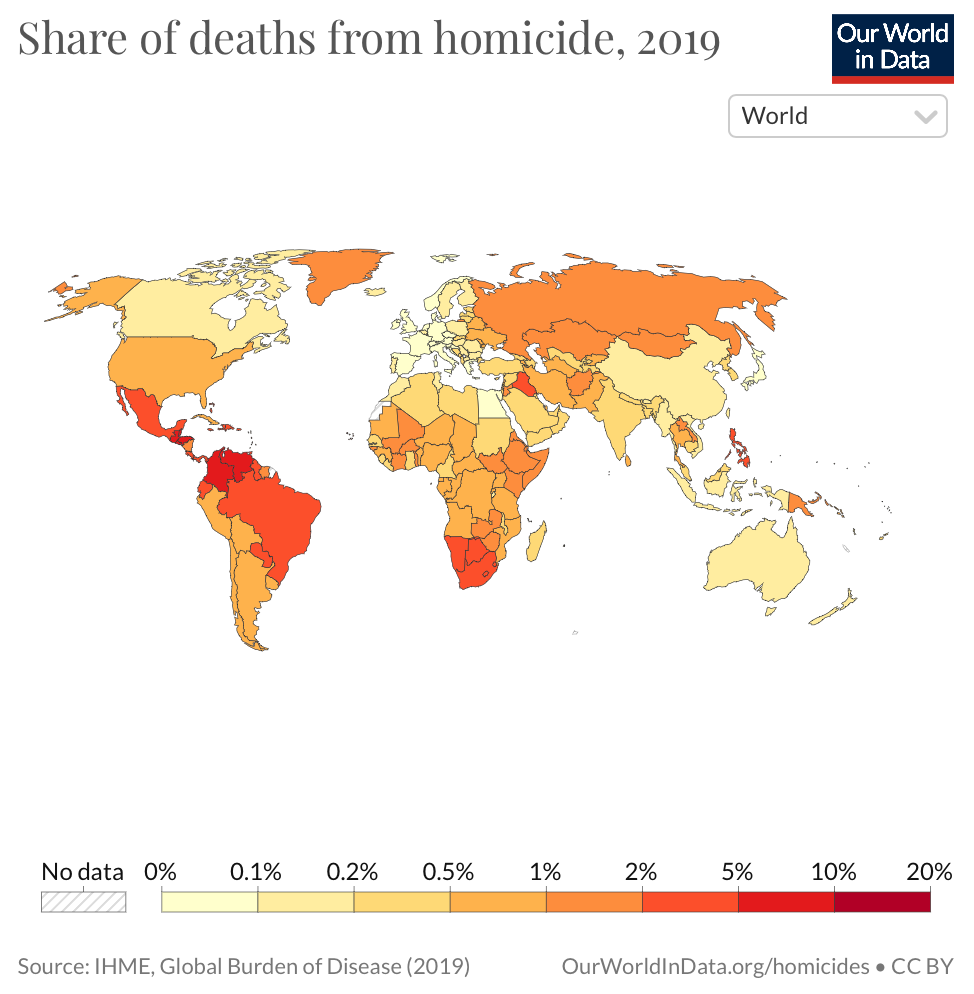
This world map shows the proportion of deaths resulting from homicide by country. There are very large differences between countries and regions.
In future posts, I aim to de-mystify murder. If you think more evolutionary theory comes in, you won’t be disappointed. Of course, I’d appreciate hearing about your theories for why violence and especially lethal violence is lower in some contexts than others.
You say that “ humans have evolved from when our ancestors were living in small nomadic bands of hunter-gatherers” without mentioning genetic v. social evolution. But perhaps that’s part of what you will go on to discuss?