Vladimir Putin
Religious autocrat

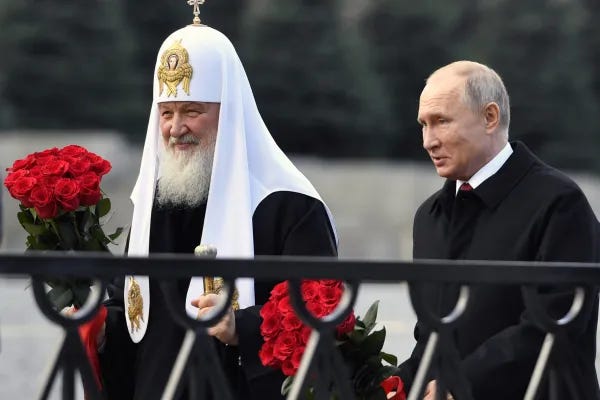
Image: Patriarch Kirill and Vladimir Putin, foreignaffairs.com
In the centre of Kyiv are some of Orthodox Christianity’s most sacred sites. The Monastery of the Caves and Saint Sophia Cathedral, both World Heritage sites are a few of many. Ukraine’s nuclear reactors have been targeted by the invading Russian forces. The Babi Yar memorial to the Holocaust has been hit. Apartment buildings, schools and pre-schools, even hospitals have been shelled and rocketed. But these sacred sites are so far untouched, and they present a dilemma for Putin.
Vladimir Putin has held power over Russia since 2000. The first twelve years things went well, oil prices were high, the country’s GDP went as high as 10%. Since 2012 growth (reported by the World Bank) has been low or negative. Over 2013-2020 Russia has averaged annual GDP growth of .54%. For comparison, NZ has managed 3% over that period.
At present Putin is enjoying high levels of popularity. Putin’s trick is to use the media and other institutions to portray himself as the solution to the problems Russia faces. Those include the threat Russia faces from NATO and Western democracies. Invasion of neighbours (Georgia in 2008, Crimea and border provinces of Ukraine in 2014, and now all of Ukraine) helps reinforce Putin’s status as a protector of the nation.
There are a couple of aspects to his support. No media are presenting an alternative view to the official channels. Your average Russian sees a world of alternative truth – where Russians are wiping Ukraine clean of Nazis.
We have seen in New Zealand how feeding the story of evil elites can mobilize a worried group into a mob of haters. That’s with ready access to alternative views. In Putin’s tightly controlled Russia it is easy to ensure that the population buys into simple stories around the theme of ‘your problems are the result of internal and external enemies.’
Another profound aspect of Putin’s power is his tight relationship with the Russian Orthodox church. Apart from the cronies he has installed to manage the armed forces, the media and lucrative franchises, Putin has a special relationship with Patriarch Kirill, the Patriarch of Moscow and all Russia.
This ensures Putin has another, supernatural, reach into the minds of the Russian people.
Looking objectively at Putin, as a collection of psychologists and political scientists have done (coordinated by Alessandro Nai of the University of Amsterdam), there is agreement that he is high in ‘Dark Triad’ traits (comprising Machiavellianism, psychopathy and narcissism). This suggests, as well as an inclination to pose with his shirt off and to be photographed in the role of sports sponsor, that Putin will discount the suffering of others to chase outcomes that will make him look good – in the eyes of an audience that wishes for a more glorious Russia.
There is some objective evidence, although not a lot of recent research, that the Russian public is somewhat authoritarian.
People who feel comfortable with authoritarian approaches go for a comprehensive authoritarian package – supporting the death penalty, punishment of gays, having negative views of environmentalists, and of people who support abortion or pornography. Also, they are keen on leaders coming down hard on enemies, and they are strong supporters of the church as standard-bearers for moral order.
Patriarch Kirill is also aligned with this package. Putin and Kirill have a mutually supportive relationship – clearly aligned on the identification of threats to Russia, and the way to deal with those – vigorously. As a small example – reacting to punk group Pussy Riot performing at Christ the Saviour Cathedral, Kirill said they were “doing the work of Satan and should be punished.” Putin later signed a bill imposing jail terms and fines for insulting people’s religious feelings.
Both Putin and Patriarch Kirill have high levels of support. Both have shared interests – including being seen to defend the sanctity of religious sites. That includes the sacred sites in Kyiv.
There are a few risks to this other dark triad (Putin, the Patriarch and the Russian public).
A particular one is the role of the Orthodox Church in Ukraine. Patriarch Kirill sees the Russian Orthodox church as having religious hegemony over Ukraine and beyond. And there are certainly Orthodox priests in Ukraine who follow the Russian line.
When Russia moved on Crimea and Ukraine’s eastern provinces of Donetsk and Luhansk in 2014, one of many reactions was the emergence of the Ukrainian Orthodox church with a Ukrainian Patriarch – Patriarch Filaret, who, along with Ukrainian Orthodox priests has been mobilizing support for Ukraine since the invasion.
Meanwhile there is not total solidarity in Russia’s Orthodox church. After this February’s invasion close to 300 Russian Orthodox priests have signed an open petition calling for an immediate ceasefire. Patriarch Kirill did not join them.
Possibly these religious divisions will play out in parallel to the armed invasion. After the Russian military victory Ukrainian priests will be disabused of their wrongful non-Russian Orthodox views. Or they will become a part of the underground fight against the invaders.
What is sure, if there is any damage to Ukraine’s sacred sites, Russians will be told who to blame – not Putin of course.
Stewart Forsyth is an organisational psychologist and executive coach and also the author of 21 Remarkable People – available from Amazon or Apple or other eBook sources.