Winston Churchill
His flaws give clues about effective leadership

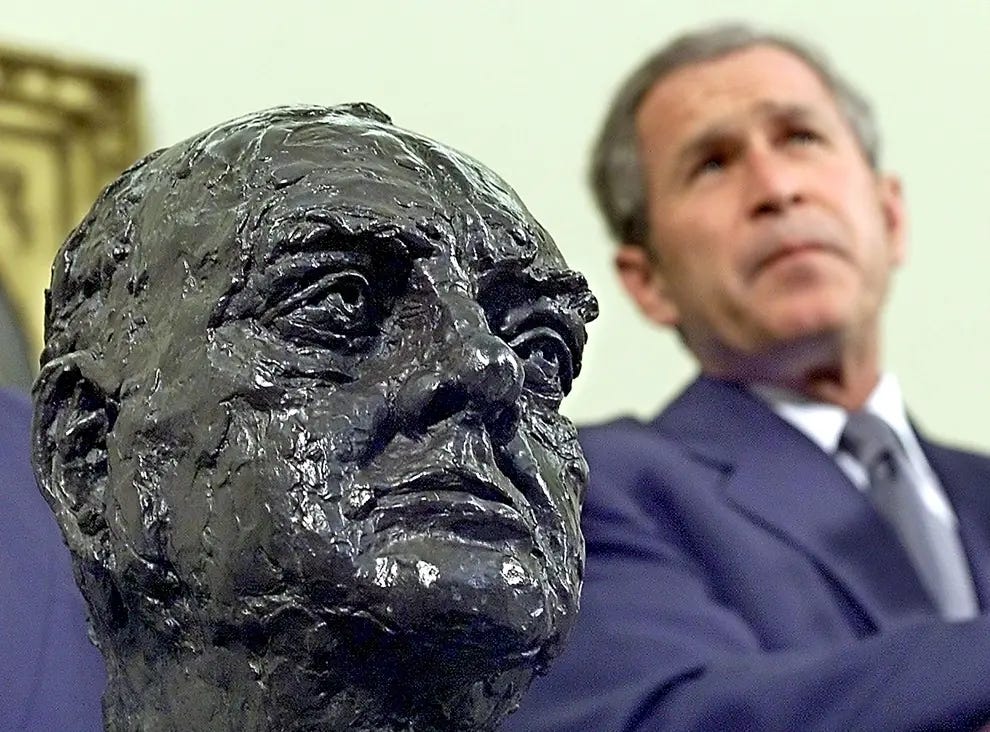
Image: independent.co.uk
Winston Churchill is much admired. A global 2013 survey of CEOs by PricewaterhouseCooper asked which leader they most admired – Churchill took out the cigar.
George W. Bush when installing a bust of Churchill in the oval office in 2001 described him as a leader who “knew what he believed.” Bush continued, “He really kind of went after it in a way that seemed like a Texan to me. He wasn’t afraid of public opinion polls. He didn’t need focus groups to tell him what was right. He charged ahead, and the world is better for it.” And, a few years later, in 2003, Bush blundered into Iraq.
Possibly Bush hadn’t heard of Gallipoli. That ended badly too. Over 44,000 Allied troops died in what Churchill described as “a legitimate war gamble”. It ended badly for Churchill as well – he resigned as First Lord of the Admiralty in November 1915. Over 4,500 Americans died in Iraq (total deaths are estimated between 31,600 and 37,300). It is difficult to justify Bush’s declaration of victory later in 2003 (the ‘mission accomplished speech’).
Churchill was a great speaker. His 1915 resignation speech was “a triumph” according to a journalist from The Times. It was met with a standing ovation. At a dinner party, and in the midst of struggling for his political life, Margot Asquith, wife of the Prime Minister, and acerbic commentator observed; “By dint of talking loud, he managed to silence the table, and with the glee of a schoolboy he harangued in his habitual, highly coloured, amusing way.”
Churchill was notably lacking in tolerating alternative views. Lady Asquith again - “Winston has no imagination of the heart,” in response to another contemporary politician – Lloyd George, who was complaining of Churchill’s folly of taking on the Turks at Gallipoli (quotes from Andrew Roberts, 2018).
Churchill had a great theme – the preservation of the British Empire. In the 1930s, as Hitler and other autocrats rose to power across Europe, Churchill spoke out, with little support, against the threat of fascism. He spoke of the threat to democracy, but he was energised by the threat to the Empire.
His weakness was the weakness of an advocate – to see the world in terms of a single cause. He fought against independence for India and other colonial prizes, the loss of which would weaken the Empire. When it was suggested he meet a visiting delegation of Indian politicians, he replied; “I am quite satisfied with my views on India, and I certainly don’t want them disturbed by any bloody Indian” (Roberts).
Possibly, his view of the right of the British to hold dominion over other peoples led to him misjudging the Turks, and their ability to repulse the attempted invasion.
Do you have the ability to talk yourself (and maybe others) into misguided action? Churchill guarded against this inclination in the Second World War. He brought together all involved in making strategic decisions. He did not over-rule his Chiefs of Staff, and he insisted on them expressing a view.
This, rather than single-minded following of a big idea contributed to his greatness as a war leader.
Stewart Forsyth is an organisational psychologist and executive coach and also the author of 21 Remarkable People – available from Amazon or Apple or other eBook sources.