Women working in STEM
Seen and not heard?

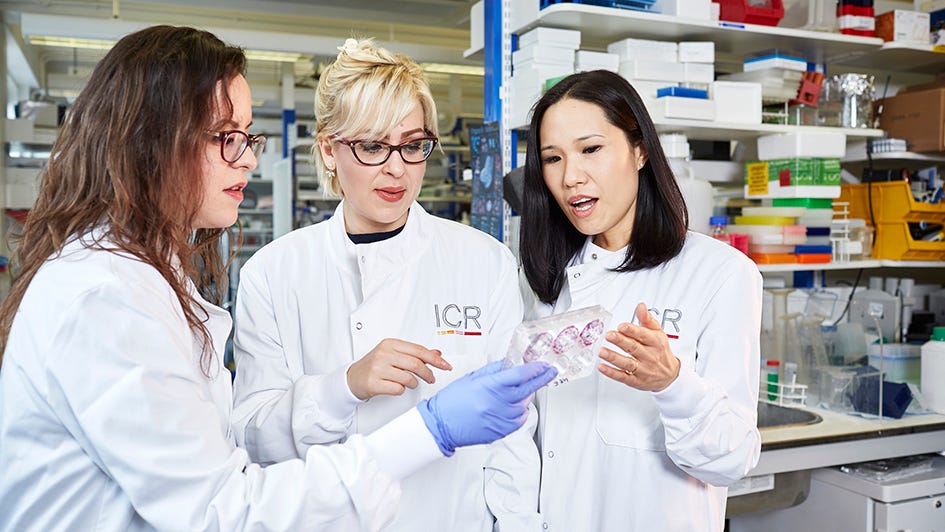
Image: Women scientists, Institute for Cancer Research; icr.ac.uk
You might have heard this story. John Glenn, the first American in space is told before the launch that the new IBM computer has been used to calculate the trajectory of his orbit and re-entry. “Get the girl to check the figures” he replies, referring to 44-year-old African American Katherine Jackson. She does the calcs and confirms he is good to go.
How about this story? Francis Crick and James Watson are racing to define the structure of the DNA molecule. They latch onto the brilliant chemist Rosalind Franklin who is using X-ray crystallography to look at the structure of molecules, including the building blocks of viruses. Her work produced images of DNA, confirming its double-helix structure. More importantly, her calculation of angles of alignment between DNA’s component molecules provided the basis for confirming the mathematical model of the double-helix. Crick and Watson and Maurice Wilkins, another contributor, get the Nobel Prize.
These are old stories, right? The theme, as I hear it, is the expectation that women will do the work (including expert, demanding work) to support the success and careers of males. But that was way back when right?
How about the just-published research (in Nature) which convincingly shows that women scientists are less likely to be included as authors when research (or patents) is published. This is not a statistically significant but trivial result. Women scientists were half as likely to be cited as authors. And when women scientists do get publication credit they have done significantly more work than male colleagues who share the credit.
Employment economist Julia Lane and colleagues systematically compared records of contribution to 10,000 US research projects (from getting the funding through fieldwork, analysis, data visualisation and write-up) to credit given by way of authorship and found that no matter what the scientific field (including psychology) there was a consistent gap for women between contribution and recognition. This held for different career stages (for example; student, post-doc, tenured staff).
An extensive survey of authors asking them about their contribution to a particular published paper (over 2,000 responded) found the same gap. A consistent response from women scientists is that they are not heard. Or, in a noisy and competitive research environment, they “don’t shout loudly enough”.
In discussing the results with Roland Pease in the (highly recommended) Science in Action podcast Lane notes that part of the problem is that modern research is done with big teams, and those leading these teams don’t have skills in team management. So the comment about the person with the loudest voice gets noticed.
One approach – developing the leadership skills of team leaders would reduce the risk of women (and probably other minorities) being disadvantaged.
Two meta-analyses (one and two) demonstrate that team development results in improvements in team performance and productivity. Another benefit of improving team dynamics would be greater clarity about the contribution made by team members, ensuring appropriate recognition and future opportunities.
Stewart Forsyth is an organisational psychologist and executive coach and also the author of 21 Remarkable People – available from Amazon or Apple or other eBook sources.